


Transformer Moisture Monitoring: Moisture in Oil and Paper Insulation Explained
发布时间:2026年10月6日 15:07:22
- Where the water is: in a service transformer, over 95% of the water sits in the cellulose insulation (paper and pressboard). Only a small fraction is dissolved in the oil, but oil is the part you can sample and measure.
- What to measure: water content in oil (ppm or mg/kg), relative saturation of the oil (%RS), oil temperature, and the estimated moisture content of the paper (% by dry weight).
- Why oil ppm alone misleads: mineral oil can hold far more water when hot. The same 20 ppm can be a dry reading at 80 °C and a near-saturated reading at 20 °C. Relative saturation and temperature must be read together.
- Why it matters: moisture speeds up cellulose ageing, lowers dielectric strength, lowers the temperature at which gas bubbles form at the hot spot, and raises the risk of partial discharge and flashover.
- How to monitor: use periodic Karl Fischer lab tests for verification, an online capacitive moisture sensor for continuous %RS trending, and dielectric response testing (FDS/PDC) to measure the paper directly.
- What to do about it: find and fix the ingress path first, then dry the oil and the paper. Filtering oil alone does not dry a wet winding.
Table des matières
- 1. Moisture Sources and Ingress: Silica Gel Breather, Gaskets and Cellulose Ageing
- 2. Water Solubility and Relative Saturation: Capacitive Moisture-in-Oil Sensor
- 3. Moisture in Paper Insulation: Pressboard, Kraft Paper and FDS/PDC Dielectric Response Tester
- 4. Oil-Paper Equilibrium Curves and Oil Temperature Probe Requirements
- 5. Effects of Moisture: Bubble Evolution, Fiber Optic Hot Spot Sensor and Dielectric Strength
- 6. Karl Fischer Titrator and Oil Sampling Syringe Practice
- 7. Online Moisture Monitor: Valve-Mounted Sensor Specifications and DGA Integration
- 8. Alarm Thresholds for Moisture Sensors: Relative Saturation and Paper Moisture Levels
- 9. Moisture Removal: Vacuum Oil Purifier, Hot Oil Circulation and Desiccant Breather
- 10. Gateway, Modbus Output and SCADA Trending for Moisture Data
- 11. Installation and Commissioning Checklist for Moisture Sensor Adapters
- 12. FAQ: Transformer Moisture Monitoring Questions
1. Moisture Sources and Ingress: Silica Gel Breather, Gaskets and Cellulose Ageing
Four ways water gets into a transformer
- Residual moisture from manufacture: new insulation is dried in a vacuum oven, but a small amount of water always remains in the paper and pressboard.
- Atmospheric ingress: breathing transformers draw in humid air. A saturated silica gel breather, a cracked breather jar or a failed oil seal lets water vapor reach the conservator.
- Leaks: aged gaskets, bushing seals, cover bolts, radiator valves and cable boxes can admit moisture, especially when the transformer cools and the internal pressure drops.
- Internal generation: when cellulose degrades, it releases water. Oil oxidation adds a small amount more. A transformer with old paper therefore makes its own moisture, even with a perfect seal.
Ingress risk by design
| Design | Main Ingress Path | Typical Protection | Monitoring Focus |
|---|---|---|---|
| Free-breathing conservator | Breather and conservator air | Silica gel or membrane breather | Breather condition, oil %RS trend |
| Rubber bag or diaphragm conservator | Bag damage, seals | Bag integrity checks | Sudden %RS rise |
| Sealed (hermetic) tank | Gasket leaks, corrugated fin cracks | Pressure control | Slow trend, tank pressure |
| Gas cushion system | Nitrogen supply contamination | Dry nitrogen | Gas dew point, oil %RS |
Warning signs of ingress
- A steady rise in oil relative saturation at similar load and temperature.
- A breather whose silica gel changes color within days after being replaced.
- A sudden jump in water content after heavy rain or after maintenance on the tank.
- A rising CO and CO₂ trend together with moisture, which points to ageing paper as the source of the water. The gas side of this is covered in dissolved gas analysis in transformers.
2. Water Solubility and Relative Saturation: Capacitive Moisture-in-Oil Sensor
Why temperature changes the ppm reading
Water dissolves in mineral oil in proportion to temperature. The saturation limit rises steeply as the oil warms, so the ppm reading changes during a daily load cycle even when the total water in the transformer has not changed.
| Température de l'huile | Approx. Saturation Limit (mineral oil) | Reading of 20 ppm Equals |
|---|---|---|
| 0 °C | about 23 ppm | about 90% RS |
| 20 °C | about 55 ppm | about 36% RS |
| 50 °C | about 175 ppm | about 11% RS |
| 80 °C | about 450 ppm | about 4% RS |
Values are approximate for new mineral oil. Aged, oxidized oil dissolves more water, and other oil types such as natural or synthetic esters have much higher saturation limits.
How a capacitive moisture sensor works
- Sensing element: a thin polymer film between two electrodes. The film absorbs water until it is in balance with the oil, and its capacitance changes with the water activity.
- Direct output: relative saturation (%RS), which does not depend on temperature in the same way ppm does.
- Calculated output: the device combines %RS with a built-in temperature probe and the oil's solubility curve to display ppm.
- Why %RS is the better trend value: it tracks the real moisture stress on the insulation, regardless of load cycle.
3. Moisture in Paper Insulation: Pressboard, Kraft Paper and FDS/PDC Dielectric Response Tester
Why paper moisture is the number that matters
Paper and pressboard form the solid insulation in the windings and between windings. They hold the water, they carry the mechanical and dielectric load, and they age when wet. The oil is only a convenient indicator.
Typical moisture classes for paper
| Paper Moisture (% dry weight) | Condition | Typical Meaning |
|---|---|---|
| Below 1% | Very dry | New or recently dried transformer |
| 1% to 2% | Dry | Normal for a healthy in-service unit |
| 2% to 3% | Moderately wet | Faster ageing, investigate the source |
| 3% to 4% | Wet | Plan drying, limit overloads |
| Above 4% | Extremely wet | High risk of bubbling and discharge, act promptly |
How paper moisture is determined
- Dielectric frequency response (FDS) or polarization and depolarization current (PDC): an offline test that measures the insulation as a system, and then calculates the moisture in the solid insulation and the oil conductivity separately. It is the most reliable non-invasive method for a whole winding.
- Equilibrium curves: an estimate from oil %RS and temperature, as explained in the next section. It is quick but depends on stable conditions.
- Paper sample analysis: only practical during an outage or an internal inspection, and only for a small piece of material.
Method comparison
| Méthode | Measures | Online or Offline | Typical Accuracy | Best Use |
|---|---|---|---|---|
| Karl Fischer titration | Water in oil sample (ppm) | Lab (offline) | About ±2 ppm or ±5% of reading | Reference measurement |
| Capacitive %RS sensor | Oil relative saturation, temperature | Online | About ±3 %RS | Continuous trend and alarm |
| Equilibrium curve estimate | Paper moisture (indirect) | Calculated | About ±1% moisture, wider when not in equilibrium | Screening |
| FDS / PDC test | Paper moisture (direct) | Offline, on site | About ±0.5% moisture | Condition assessment and drying decision |
4. Oil-Paper Equilibrium Curves and Oil Temperature Probe Requirements
How water moves between paper and oil
- When the transformer heats up: water leaves the paper and enters the oil. Oil ppm rises, but %RS may stay almost constant.
- When it cools down: water returns to the paper. The oil becomes drier in ppm terms.
- Time constants: the oil reaches balance with the paper in hours to days, while the paper itself changes over weeks to months. A reading taken right after a load change is not in equilibrium.
Indicative relation of %RS to paper moisture
| Oil Relative Saturation | Indicative Paper Moisture |
|---|---|
| Below 5% RS | Below 1% |
| 5% to 10% RS | About 1% to 2% |
| 10% to 20% RS | About 2% to 3% |
| 20% to 30% RS | About 3% to 4% |
| Above 30% RS | Above 4% |
This mapping is indicative only, because equilibrium curves vary with paper type, ageing and oil condition. Use it to rank risk, and confirm with an FDS/PDC test before a drying decision.
Temperature measurement requirements
- Use the oil temperature at the sensor: the moisture sensor must have its own temperature probe in the same oil stream.
- Use the top oil temperature trend: for estimating paper moisture, readings taken at steady load and a top oil temperature of roughly 40 °C or higher are more reliable than cold readings.
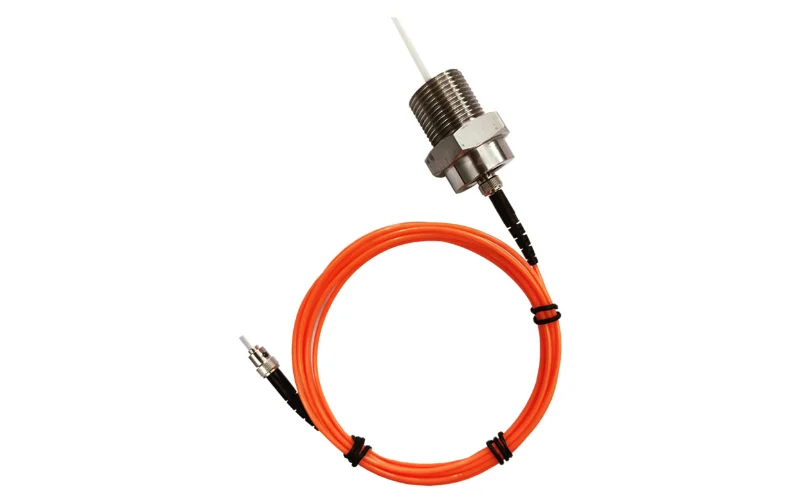
- Know the hot spot: the hot spot is where bubbles form first, so a direct winding measurement from a winding hot spot temperature sensor gives a more realistic view of the risk than top oil temperature alone.
5. Effects of Moisture: Bubble Evolution, Fiber Optic Hot Spot Sensor and Dielectric Strength

Ageing of paper
Water takes part in the hydrolysis that breaks the cellulose chains, so the paper loses mechanical strength faster as it gets wetter. As a rule of thumb, the ageing rate roughly doubles each time the moisture content doubles.
| Paper Moisture | Relative Ageing Rate (rule of thumb) |
|---|---|
| 0.5% | 1 (reference) |
| 1% | about 2 |
| 2% | about 4 |
| 4% | about 8 |
Bubble evolution during overload
- Mechanism: when the hot spot passes a critical temperature, water vapor leaves the paper as bubbles. Gas bubbles in a high-field region can start partial discharge or cause a breakdown.
- Moisture lowers the limit: a dry winding tolerates a very high hot spot, while a wet one can bubble at a temperature that normal emergency loading would reach.
| Paper Moisture | Approx. Bubble Evolution Temperature |
|---|---|
| 1% | about 160 °C |
| 2% | about 140 °C |
| 3% | about 125 °C |
| 4% | about 115 °C |
| 5% | about 105 °C |
Values are approximate and depend on gas content and pressure in the oil. A fiber optic probe that reads the hot spot directly, as described in fiber optic temperature measurement in transformers, lets operators compare the real winding temperature against this limit during an overload.
Other effects
- Lower breakdown voltage of oil: water, especially with particles or fibers, reduces the AC breakdown strength.
- Higher dielectric losses: power factor (tan δ) of the insulation rises with moisture.
- Free water at low temperature: a wet transformer that is cooled or restarted from cold can release free water, which is a flashover risk.
- Bushing and tap changer impact: wet oil in an OLTC compartment or around bushings speeds up contact and insulation problems.
6. Karl Fischer Titrator and Oil Sampling Syringe Practice
Why Karl Fischer is the reference
Coulometric Karl Fischer titration (IEC 60814, ASTM D6304) reacts the water in an oil sample with iodine and calculates the exact mass of water. It is the reference against which online sensors are verified.
Sampling rules
- Record the oil temperature: note the top oil temperature at the time of sampling, because the ppm number is meaningless without it.
- Sample at a steady state: take samples after several hours at stable load, not right after a switching event.
- Use a closed sampling system: a glass syringe or a metal sample bottle with a stopcock, flushed with the oil being sampled, avoids contact with room air.
- Avoid cold, damp weather: or shield the sampling point, because moist air can add water to the sample in minutes.
- Test promptly: deliver the sample to the lab quickly, and use the same lab and method each time for consistent trends.
Combining lab tests and online data
- Use a Karl Fischer result to confirm the online sensor once a year, and after any suspicious alarm.
- Compare the lab ppm with the online ppm at the same oil temperature, and not with the online %RS.
- For a view of what an online device adds beyond periodic samples, see online DGA vs oil sampling, which uses the same logic for gases.
7. Online Moisture Monitor: Valve-Mounted Sensor Specifications and DGA Integration
Typical online sensor specifications
| Article | Typical Value |
|---|---|
| Moisture measuring range | 0 to 100% RS |
| Moisture accuracy | about ±3% RS (±2% RS in the 0 to 30% range for better models) |
| Calculated ppm range | depends on oil temperature and oil type |
| Oil temperature range | -40 °C to 120 °C |
| Oil temperature accuracy | about ±1 °C |
| Response time to a step change | minutes to tens of minutes (oil flow dependent) |
| Montage | Drain or sampling valve, threaded adapter (check size on site) |
| Output | RS485 Modbus RTU, 4–20 mA, relay |
| Supply | AC 220 V or DC 24 V |
The values above are typical for this type of sensor, so confirm against the product datasheet before specifying.
Sensor mounting rules
- Place in a flowing region: mount on a valve where oil circulates, such as the radiator inlet or the main tank wall, and not on a dead-end pocket.
- Install through an isolation valve: so the sensor can be removed without draining the tank.
- Keep the probe immersed: avoid sensor positions above the minimum oil level, and bleed any trapped air.
- Avoid direct sun: a hot enclosure or sun-exposed pipe can add temperature error.
Combining moisture with gas and temperature
- Same valve, same device: many installations pair the moisture sensor with an online DGA monitoring system for transformer oil, so gas, moisture and temperature share one oil connection.
- Cross-checking: a rise in moisture with a rise in CO and CO₂ points to cellulose degradation, while a rise in moisture with no gas change points to external ingress.
- Wider oil picture: moisture sits alongside acidity, breakdown voltage and dissolved gases in an overall transformer oil health monitoring program.
8. Alarm Thresholds for Moisture Sensors: Relative Saturation and Paper Moisture Levels
Four-level alarm scheme
| Level | Oil Relative Saturation | Indicative Paper Moisture | Recommended Action |
|---|---|---|---|
| Normal | Below 10% RS | Below 2% | Continue routine monitoring, annual verification sample |
| Watch | 10% to 20% RS | 2% to 3% | Increase sampling, check breather and seals |
| Warning | 20% to 30% RS | 3% to 4% | Find the ingress path, run an FDS/PDC test, plan drying, restrict overload |
| Critical | Above 30% RS | Above 4% | Limit load, avoid cold starts, start dry-out as soon as possible |
Setting rules
- Start from the standards: use IEC 60422 or IEEE C57.106 for the formal limits of water in oil by voltage class, and treat the table above as a starting point only.
- Add rate-of-change alarms: a rise of several %RS in a few weeks is a stronger warning than a high but stable value.
- Use delays and averages: use a 24-hour moving average to avoid alarms caused by daily load cycles.
- Link to loading limits: when moisture is high, reduce the allowed emergency overload, using the guidance in transformer temperature rise limits and ratings.
- Log all changes: record each threshold change with date, reason and approver.
9. Moisture Removal: Vacuum Oil Purifier, Hot Oil Circulation and Desiccant Breather
Drying methods
| Méthode | What It Dries | Outage Needed | Typical Duration | Notes |
|---|---|---|---|---|
| Vacuum oil purifier (online filtration) | Oil, and paper slowly | No (low-flow) or short | Weeks to months | Most practical for moderately wet units |
| Hot oil circulation with vacuum | Oil and paper | Oui | Days to weeks | Warm the windings so water leaves the paper |
| Vapor phase or vacuum drying | Paper and pressboard | Yes, often at a factory or workshop | Days to weeks | Used for very wet or critical units |
| Low-frequency heating | Paper from inside | Oui | Days | Specialist equipment needed |
| Desiccant or membrane breather | Prevents new ingress only | Non | Continuous | Does not dry existing water |
Practical points
- Fix the cause first: drying a transformer that still leaks only repeats the problem. Replace the silica gel, repair seals and check the conservator bag.
- Paper dries slowly: oil filtration lowers the oil ppm quickly, but the water in the paper returns to the oil. Verify with %RS and FDS/PDC after a rest period.
- Control the temperature: heat the winding during drying to help water leave the paper, but stay within safe temperature limits for the insulation.
- Do not dry without a baseline: compare moisture and gas data before and after, to confirm the treatment worked.
10. Gateway, Modbus Output and SCADA Trending for Moisture Data
Data points to send
| Data Point | Type | Typical Update | Use |
|---|---|---|---|
| Oil relative saturation (%RS) | Analog value | 1 to 10 min | Primary trend and alarm |
| Oil water content (ppm) | Analog value | 1 to 10 min | Comparison with lab data |
| Oil temperature at sensor | Analog value | 1 min | Context for moisture reading |
| Estimated paper moisture | Calculated value | Daily average | Condition ranking |
| Sensor fault and flow-loss flag | Status bit | On change | Data quality |
| Alarm level (normal to critical) | Status code | On change | Event log and notification |
Display and analysis points
- Plot %RS against oil temperature and load: a flat %RS trend under a changing load shows a healthy, stable system.
- Use long averages: daily and weekly averages reveal slow ingress that raw data hides.
- Combine with other data: overlay moisture with winding temperature and dissolved gas trends on one screen, as outlined in transformer monitoring dashboard and SCADA integration.
- Protocol: RS485 Modbus RTU to a gateway, then Modbus TCP, IEC 60870-5-104, DNP3 or IEC 61850 to the control system, depending on the site.
- Health scoring: moisture is one of several inputs to a transformer health monitoring system that ranks assets for maintenance.
11. Installation and Commissioning Checklist for Moisture Sensor Adapters
Before installation
- Collect nameplate data, oil type, oil volume, last Karl Fischer and FDS/PDC results and the breather type.
- Choose a valve with continuous oil flow, and confirm the valve and adapter thread sizes on site.
- Plan the outage or the safe live-work procedure for the valve connection.
- Agree on the output signal and the register map with the control team.
During installation
- Fit the isolation valve first, then the adapter, then the sensor, and bleed air at the top of the adapter.
- Use oil-compatible sealing material and tighten without over-torquing the sensor body.
- Route the signal cable away from HV parts and ground the shield at one end only.
- Seal the cable gland against moisture, and shade the sensor from direct sun if possible.
Commissioning tests
| Test | Méthode | Pass Criterion |
|---|---|---|
| Leak test | Open the isolation valve and inspect the fittings | No oil seepage |
| Temperature check | Compare with a reference thermometer on the pipe | Within sensor accuracy |
| Moisture cross-check | Take a sample for Karl Fischer testing at the same oil temperature | Online ppm within the expected tolerance |
| Alarm test | Simulate set points in the monitor | Correct relay and SCADA alarm |
| Communication test | Read all registers from SCADA | Values match the local display |
| Sensor fault test | Disconnect the sensor cable | Fault flag raised |
After commissioning
- Record baseline %RS, ppm and oil temperature at known load levels.
- Verify the sensor against a Karl Fischer sample once a year.
- Review the full set of insulation indicators through transformer insulation monitoring after any dry-out or oil treatment.
12. FAQ: Transformer Moisture Monitoring Questions
Why is moisture in transformer insulation a problem?
Moisture speeds up the breakdown of cellulose paper, reduces the dielectric strength of the oil, lowers the temperature at which bubbles form at the hot spot, and increases the risk of partial discharge and flashover. Over time, it shortens the life of the transformer.
Is most of the water in the oil or in the paper?
Most of it, over 95%, is in the paper and pressboard. The oil holds only a small share, but the two are in balance, so oil measurements can be used to estimate the paper moisture.
Why does the ppm reading change during the day?
Oil dissolves more water when it is warm, and water moves from the paper into the oil as the transformer heats up. The ppm number therefore changes with load and temperature. Relative saturation (%RS) is more stable and is the better value to trend.
What is the difference between %RS and ppm?
Parts per million is the mass of water per mass of oil. Relative saturation is the percentage of the water that the oil could hold at that temperature. Two readings of 20 ppm can mean very different risk at 20 °C and at 80 °C.
How can I measure moisture in the paper insulation?
The best direct method is an FDS or PDC dielectric response test on site, which gives paper moisture and oil conductivity. A cheaper estimate comes from oil %RS and temperature using equilibrium curves, but it is less accurate unless the transformer is in a steady state.
Is an online moisture sensor accurate enough to replace lab tests?
It is accurate enough for trending and alarms, typically around ±3% RS. Karl Fischer testing remains the reference method, so verify the sensor against a lab sample once a year and after any unexpected alarm.
Does filtering the oil dry the transformer?
It dries the oil quickly, but most of the water is in the paper, and it moves back into the oil over time. Online or hot oil vacuum processing can slowly dry the paper as well, but a very wet winding may need a full hot oil or vapor phase treatment.
Do dry-type transformers have moisture problems too?
Yes, but through condensation and humid air rather than oil and paper. In those units, winding temperature, ambient humidity and heater control matter most, as covered in dry-type transformer temperature monitoring.
How do I choose a moisture monitoring setup for my transformer?
Prepare the transformer rating, voltage class, oil type, breather type, last test results and your communication protocol, then send them to the engineering team for a matched monitoring scheme.