

Dans quels cas un transformateur nécessite-t-il une surveillance DGA en ligne ?
发布时间:6 septembre 2026, 15 h 55 min 13 s
Every transformer owner eventually asks the same question: is annual oil sampling enough, or does this unit need continuous, online dissolved gas analysis? The honest answer is that not every transformer needs an online DGA monitor — but the transformers that do need one usually need it long before anyone realizes it. Below is the short version of what this guide covers.
- Criticality first: a transformer needs online DGA monitoring when its unplanned failure would cause outage costs, production losses, or safety exposure far greater than the price of a monitor.
- Age and condition: units past roughly 20–25 years of service, or with degraded insulation, moisture ingress, or known design weaknesses, are prime candidates.
- Loading stress: transformers running near or above nameplate rating, with cyclical or reversing load flows, or feeding renewable plants and DC converters, generate fault gases faster than yearly sampling can catch.
- Warning history: any transformer with rising hydrogen, acetylene detection, past bushing or tap changer issues, or an inconclusive lab result deserves continuous surveillance.
- Spare and logistics risk: if no spare exists, lead time exceeds 12 months, or the unit is remote and hard to sample, online DGA monitoring pays for itself in risk reduction alone.
- Regulatory and insurance drivers: asset-management standards, insurer requirements, and grid codes increasingly expect continuous condition monitoring for strategic power transformers.
- What to buy: single-gas hydrogen monitors for screening, multi-gas or full nine-gas online DGA analyzers for diagnosis, moisture-in-oil sensing in both cases.
The rest of this article expands each of those points into a practical decision framework, explains what the gases actually mean, compares monitor types, and answers the questions buyers ask most often before placing an order.
What Online DGA Monitoring Means for a Power Transformer
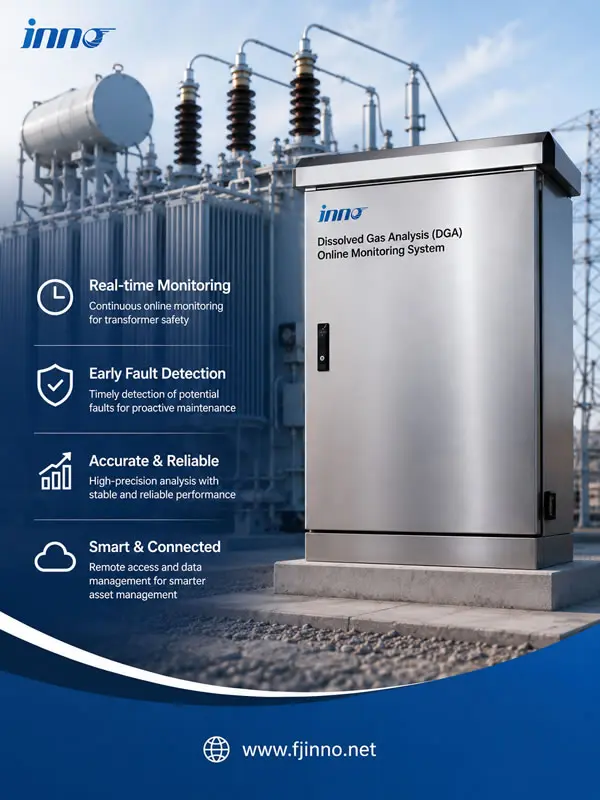
Dissolved gas analysis is the single most informative diagnostic technique available for oil-filled power transformers. When insulating oil and cellulose paper are stressed by heat, arcing, or partial discharge, they break down and release characteristic gases — hydrogen, methane, ethane, ethylene, acetylene, carbon monoxide, and carbon dioxide — which dissolve into the oil. Measuring those gases tells you what is happening inside a sealed steel tank that you cannot open, inspect, or disassemble while it is energized.
Traditional DGA is a laboratory procedure. A technician draws an oil sample into a syringe or bottle, ships it to a lab, and receives a report days or weeks later. Online DGA monitoring replaces that periodic snapshot with a permanently installed instrument mounted on the transformer that extracts gas from the oil, measures it automatically, and reports the results continuously to a control room, SCADA system, or cloud dashboard.
The distinction matters because transformer faults do not respect sampling calendars. A developing hot spot can escalate from benign to destructive in weeks. An arcing fault in a tap changer diverter can produce acetylene in hours. Online DGA monitoring converts transformer condition assessment from a retrospective exercise into a live measurement, and that is the entire value proposition.
How an Online DGA Monitor Extracts and Measures Gas
Modern online DGA monitors use one of several extraction and detection principles, and understanding them helps you assess competing quotations.
- Gas-permeable membrane extraction: oil flows past a polymer membrane that allows dissolved gases to diffuse into a measurement chamber. Simple, robust, no consumables, but equilibrium times vary by gas.
- Headspace or vacuum extraction: the instrument creates a controlled gas space above the oil and measures the equilibrium concentration. More complete gas recovery, especially for heavier hydrocarbons, at the cost of mechanical complexity.
- Photoacoustic spectroscopy (PAS): infrared light pulses excite target gas molecules, and the resulting pressure wave is detected by a microphone. No carrier gas, no column, stable over long periods.
- Non-dispersive infrared (NDIR) and tunable diode laser absorption: optical absorption at gas-specific wavelengths, excellent for hydrocarbons and carbon oxides but blind to hydrogen, which requires a separate sensor.
- Gas chromatography (GC): the laboratory reference method miniaturized for field use. Highest measurement specificity and accuracy, but requires a carrier gas supply or a carrier-free design, plus periodic column maintenance.
- Electrochemical and solid-state hydrogen sensors: low-cost, compact, used in single-gas hydrogen monitors and in hybrid instruments to cover the gas that optical methods miss.
No single technology is universally superior. What matters for procurement is the combination of gases measured, detection limits, repeatability, cross-sensitivity, calibration stability, and expected maintenance burden across a fifteen-to-twenty-year installed life.
The Fault Gases Online DGA Monitoring Detects and What They Mean
Before deciding whether a transformer needs online DGA monitoring, it helps to know precisely what the instrument would be telling you. Each gas carries a diagnostic signature, and the ratios between them identify the fault type.
Hydrogen: the Universal Early Indicator in Transformer DGA
Hydrogen is produced by essentially every fault mechanism — partial discharge, arcing, and thermal decomposition all generate it. It is the smallest molecule, diffuses fastest through oil and membranes, and typically appears first. That combination makes hydrogen the preferred single-gas screening parameter. A hydrogen-only online monitor cannot tell you what kind of fault is developing, but it will tell you that something is developing, which is often enough to trigger an immediate lab sample.
Acetylene: the Gas That Demands Immediate Action
Acetylene forms only at very high temperatures, generally above 700 °C, which in practice means arcing. Its appearance in significant quantity in the main tank is the most serious finding in transformer diagnostics. Utilities routinely treat a confirmed acetylene increase as grounds for load reduction or removal from service pending investigation. Because arcing faults can evolve rapidly toward catastrophic failure, acetylene detection capability is the strongest technical argument for continuous rather than periodic monitoring on critical units.
Methane, Ethane and Ethylene: Thermal Fault Severity in Online DGA
These hydrocarbon gases map to increasing thermal severity. Methane and ethane dominate at lower overheating temperatures; ethylene becomes prominent as hot-spot temperature climbs past roughly 300 °C toward 700 °C. The ratio of ethylene to ethane, and of methane to hydrogen, forms the basis of the classic diagnostic ratio methods. Tracking their relative growth rates over time distinguishes a stable, tolerable hot spot from a progressive one.
Carbon Monoxide and Carbon Dioxide: Cellulose Insulation Degradation
Where the hydrocarbons report on the oil, carbon monoxide and carbon dioxide report on the paper. Cellulose degradation is effectively irreversible and determines the ultimate end of life of a transformer, since the paper cannot be replaced without a full rewind. A rising CO trend, a falling CO₂/CO ratio, and elevated furan content together indicate that solid insulation is being consumed. For aging fleets, this is the parameter set that drives replacement planning rather than emergency response.
Oxygen, Nitrogen and Moisture in Online Transformer Monitoring
Oxygen and nitrogen are not fault gases, but they characterize the sealing integrity of the tank and the behavior of the conservator or nitrogen blanket. A sudden change in the oxygen-to-nitrogen ratio may indicate a leak. Moisture in oil, usually measured alongside DGA by a capacitive relative-saturation probe, is critical because water dramatically accelerates paper aging and reduces dielectric strength. Most serious online DGA monitoring systems include moisture measurement as standard, and buyers should insist on it.
Online DGA Monitoring vs Offline Oil Sampling: Where Lab Testing Falls Short
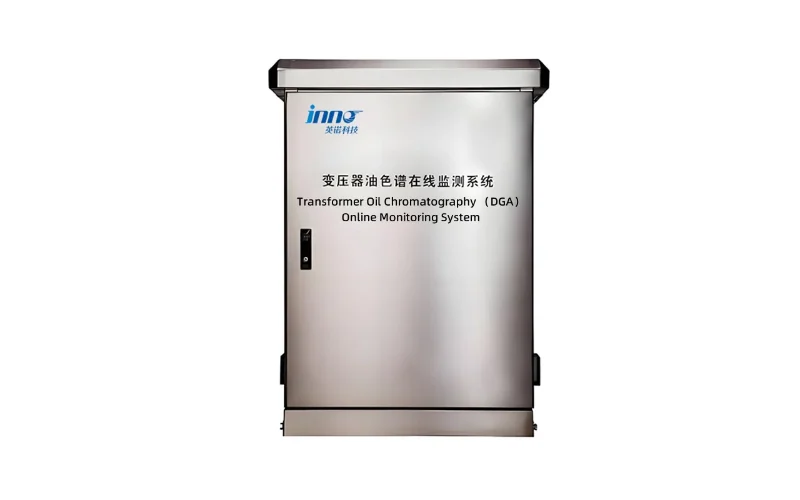
Laboratory DGA remains the reference standard for accuracy, and no credible vendor argues that online monitors eliminate the need for periodic lab confirmation. The argument is about coverage in time, not accuracy at a point in time.
| Aspect | Offline laboratory DGA | Online DGA monitoring |
|---|---|---|
| Measurement frequency | Typically annual; quarterly or monthly for units under watch | Hourly to continuous, unattended |
| Time to result | Days to weeks, including shipping and queue time | Minutes; alarms transmitted immediately |
| Detection of fast-developing faults | Poor; a fault can start and destroy the unit between samples | Strong; rate-of-change alarms trigger within a measurement cycle |
| Accuracy and gas coverage | Highest; full gas suite plus furans and oil quality | Good to excellent depending on technology; limited gas suite on entry-level units |
| Sampling error risk | Significant; air ingress, wrong valve, transit temperature, syringe leakage | Eliminated for the online measurement itself |
| Personnel exposure | Requires staff at an energized substation for every sample | None after commissioning |
| Cost profile | Low per test, recurring forever, plus travel and labor | Capital cost up front, minimal recurring cost |
| Trend quality | A handful of widely spaced points; load and temperature context unknown | Dense time series correlated with load, temperature and switching events |
The last row deserves emphasis. A single lab number is nearly meaningless without context; a transformer at 90 % load on a 38 °C afternoon will show different gas concentrations than the same transformer at 40 % load in winter. Online DGA monitoring provides the density of data needed to separate genuine fault progression from normal operational variation, and it lets you correlate gas generation with specific events — a through-fault, a switching operation, a tap changer sequence.
The practical conclusion for most asset owners is a tiered strategy: online DGA monitoring on critical and at-risk units, periodic laboratory DGA on everything, and lab confirmation whenever an online monitor raises an alarm.
When Does a Transformer Need Online DGA Monitoring? The Criticality Test
The first and most decisive screening question has nothing to do with the transformer's technical condition. It is about consequence. Ask what happens the day this unit fails without warning.
Consequence of Failure Justifies Online DGA Monitoring
Build a simple consequence score for each transformer using factors your organization can actually estimate:
- Outage impact: how many customers, how much production, how many megawatt-hours are lost per hour of downtime? A generator step-up transformer at a 600 MW plant and a rural distribution substation transformer are not in the same category.
- Replacement lead time: large power transformers commonly carry lead times of 12 to 24 months or more in a tight market. If the replacement clock is measured in seasons, early warning is worth a great deal.
- Spare availability: is there an identical or compatible spare on site, in the region, or nowhere at all? Non-standard voltage ratios and impedances often mean no practical spare exists.
- Redundancy: is the transformer N-1 protected, or is it a single point of failure? Redundancy does not eliminate the case for monitoring, but it changes the urgency.
- Safety and environmental exposure: a violent tank rupture releases burning oil. Proximity to occupied buildings, control rooms, water bodies, or other assets raises the stakes sharply.
- Contractual and reputational penalties: availability guarantees, industrial customer contracts, and regulatory reliability metrics all convert transformer downtime into direct financial loss.
Where the answers to these questions produce a large number, online DGA monitoring is almost always justified regardless of the unit's current health. Monitoring the healthy critical transformer is exactly the point — you install it before there is a problem so that you have a baseline trend when a problem starts.
Transformer Categories That Typically Warrant Online DGA Monitoring
Across utilities, industry and renewables, certain transformer roles consistently justify continuous monitoring:
- Generator step-up (GSU) transformers at thermal, hydro, nuclear, and large renewable plants, where the unit is directly in the revenue path and rarely has a spare.
- Transmission autotransformers at 220 kV, 400 kV, 500 kV and above, especially interconnection points and units serving large load centers.
- HVDC converter transformers, which experience harmonic and DC stresses well beyond conventional service duty.
- Furnace and rectifier transformers in steel, aluminum smelting, electrolysis, and electrochemical plants, subject to severe harmonics and rapid load swings.
- Offshore wind substation transformers and other assets where physical access for sampling is expensive, weather-dependent, or seasonally impossible.
- Mining, oil and gas, petrochemical, and data center transformers where the downstream process cannot tolerate an unplanned outage.
- Railway traction transformers with highly cyclical and unbalanced loading.
- Any transformer supplying a hospital, airport, water treatment plant, or other critical public infrastructure.
Transformer Age and Insulation Condition Triggers for Online DGA Monitoring
Design life for a power transformer is often quoted as 25 to 40 years, but service life depends overwhelmingly on thermal history and moisture. Well-maintained units regularly exceed 50 years; badly loaded or wet units fail far earlier. Age alone is a crude proxy, yet a useful one for fleet screening.
The Aging Fleet Problem That Drives Online DGA Monitoring Demand
Large portions of the installed transformer base in North America, Europe, Japan, and parts of Asia were commissioned during the build-out decades of the 1960s through 1980s. Those units are now at or beyond nominal design life, while replacement budgets and manufacturing capacity cannot possibly replace them all on schedule. The realistic strategy is condition-based life extension: keep the units in service, but know their condition well enough to intervene before failure. That is precisely the role online DGA monitoring plays, and it is why the global market for transformer condition monitoring has grown steadily.
Condition Indicators That Move a Transformer Onto the Monitoring List
- Degree of polymerization below roughly 500: paper strength has already declined significantly and mechanical fault tolerance is reduced.
- Elevated furan content in oil, indicating measurable cellulose degradation.
- High moisture in paper estimated from oil moisture and temperature, since water accelerates aging roughly exponentially.
- Poor oil quality: low interfacial tension, high acidity, high dissipation factor, sludge formation.
- History of through-faults from downstream short circuits, which mechanically stress windings and clamping structures.
- Known design or manufacturing weaknesses in a particular vintage or model, including problematic bushing types, lead exit designs, or tap changer models with documented failure histories.
- Previous repairs, rewinds, or oil processing, which reset gas baselines and can introduce new failure modes.
- Unknown history, including second-hand units, relocated transformers, and assets acquired with a facility purchase where maintenance records are incomplete.
The last item is more common than people expect. A transformer with no reliable maintenance history is effectively an unknown risk, and installing an online DGA monitor is the fastest way to establish a trustworthy baseline within a few months instead of a few years.
Loading, Renewables and Grid Duty: Operating Triggers for Online DGA Monitoring
A transformer's thermal and dielectric stress depends on how it is used, and modern grid operation has made that usage far harsher than the original design assumptions in many cases.
Overloading and Cyclic Loading Increase the Need for Continuous DGA
Hot-spot temperature drives insulation aging, and aging rate approximately doubles for every 6 to 8 °C increase. Transformers routinely loaded above nameplate rating, or operated with emergency overload ratings during contingencies, accumulate thermal damage quickly. Cyclic loading adds mechanical stress from repeated thermal expansion and contraction, which can loosen clamping and winding structures over time. Where dynamic loading or emergency ratings are used deliberately as a capacity strategy, continuous gas monitoring is close to mandatory — it is the feedback loop that tells you whether the loading policy is actually safe.
Renewable Integration and Power Electronics Change Transformer Stress Profiles
Wind and solar plants impose duty cycles that legacy transformer designs were never validated against: frequent ramping, reverse power flow, extended light-load operation, and harmonic content from inverters. Wind turbine step-up transformers experience mechanical vibration and wide temperature swings. Solar plant transformers cycle daily from near-zero to full output. Battery energy storage transformers may reverse power flow multiple times per day. In each case, the gas generation profile differs from conventional service, which means historical utility experience is a weak guide and direct measurement is a strong one.
Harmonics, DC Bias and Geomagnetic Effects
Harmonic currents cause additional eddy-current and stray losses that concentrate heat in structural parts and winding regions not captured by top-oil temperature. DC bias from HVDC ground return, geomagnetically induced currents, or unbalanced power electronics can drive a transformer core into half-cycle saturation, producing localized overheating and characteristic gassing. These are exactly the fault mechanisms that produce gradual hydrocarbon generation and that periodic sampling may attribute to normal aging until damage is advanced.
Remote and Access-Restricted Sites Favor Online DGA Monitoring
The economics of monitoring shift decisively when sampling is expensive. An offshore substation requiring a vessel and weather window, a mountain hydro station reachable only in summer, a desert solar farm hours from the nearest lab, an unmanned substation in a security-sensitive region — in all of these, the cost of a single manual sample can approach a meaningful fraction of a monitor's price. Add the personnel safety benefit of not sending technicians to energized equipment, and the case becomes straightforward.
Warning Signs From Past Test Results That Justify Online DGA Monitoring
The strongest technical trigger is a transformer that has already told you something is wrong. Any of the following findings from routine testing should move a unit onto continuous monitoring immediately.
- Any confirmed acetylene in the main tank, even at a few parts per million, where no tap changer oil communication explains it.
- Hydrogen trending upward across consecutive samples, particularly with an increasing rate of change rather than a step and plateau.
- Total dissolved combustible gas (TDCG) crossing into the higher condition categories defined by IEEE C57.104 or exceeding typical values in IEC 60599.
- Rising carbon monoxide with a declining CO₂/CO ratio, pointing to active paper degradation rather than historical aging.
- Contradictory or inconclusive lab results between consecutive samples, which often indicate sampling error but occasionally indicate an intermittent fault.
- Gas relay (Buchholz) operations or alarms, even if the collected gas analysis appeared benign.
- Partial discharge detected by acoustic, UHF, or electrical measurement.
- Abnormal results from other tests: changed winding resistance, changed frequency response analysis signature, elevated bushing power factor or capacitance change, increased core insulation resistance issues.
- Tap changer anomalies: abnormal contact wear, motor drive irregularities, or contact resistance drift, particularly on units where OLTC and main tank oil systems are not fully isolated.
- Cooling system problems: failed pumps or fans, blocked radiators, or persistent high top-oil temperature.
In these cases, the question is not really whether to monitor; it is whether to monitor with a hydrogen-only unit as a tripwire or with a full multi-gas analyzer capable of diagnosing the fault type without pulling the transformer out of service.
Which Transformers Do Not Need Online DGA Monitoring Yet
Credibility requires acknowledging the other side. Online DGA monitoring is not free, and blanket deployment across an entire fleet rarely produces the best return on a maintenance budget. Transformers that generally do not justify a monitor include:
- Small distribution transformers, typically below a few MVA, where replacement cost is comparable to or lower than the monitor and spares are readily available from stock.
- Fully redundant units in an N-2 configuration serving non-critical loads, where a failure means switching rather than an outage.
- Units already scheduled for replacement or retirement within a short horizon, where the monitor cannot be redeployed usefully.
- Dry-type and cast-resin transformers, which contain no oil and therefore no dissolved gas to analyze; these are monitored by temperature, partial discharge, and thermal imaging instead.
- Transformers in easily accessible locations with strong, well-documented lab sampling programs, stable gas histories, and moderate criticality — where increasing sampling frequency is the cheaper next step.
A sensible fleet strategy assigns each transformer to a monitoring tier: no monitoring beyond routine sampling, temperature and moisture monitoring only, single-gas hydrogen monitoring, or full multi-gas online DGA monitoring. The tiering exercise itself often reveals that ten to twenty percent of a fleet accounts for the large majority of failure consequence.
Choosing Between Single-Gas, Multi-Gas and Nine-Gas Online DGA Monitors
Once a transformer qualifies for monitoring, the next decision is what class of instrument to install. The market divides fairly cleanly into three tiers.
| Monitor class | Gases measured | Best suited to | Diagnostic capability |
|---|---|---|---|
| Single-gas (hydrogen) | H₂, usually plus moisture in oil | Medium-criticality units, large fleet screening, budget-constrained deployment | Detects that a fault exists; cannot classify it |
| Multi-gas (3 to 5 gases) | Typically H₂, CO, C₂H₂, C₂H₄, CH₄ plus moisture | Important transmission and industrial transformers | Supports basic ratio diagnostics and thermal vs electrical fault discrimination |
| Full nine-gas | H₂, CH₄, C₂H₆, C₂H₄, C₂H₂, CO, CO₂, O₂, N₂ plus moisture | GSU, HVDC converter, critical autotransformers, high-value assets | Full Duval Triangle and Pentagon, Rogers and IEC ratio methods, paper degradation assessment |
When a Hydrogen-Only Online Monitor Is Enough
Hydrogen monitors are attractive for fleet-wide coverage because their cost allows deployment across dozens of units for the price of a handful of full analyzers. They function as tripwires: when hydrogen rises past a threshold or a rate-of-change limit, dispatch a technician to take a lab sample and decide from there. For a utility with hundreds of medium-importance transformers and a functioning sampling program, this is often the highest-value spend per dollar.
When Full Multi-Gas Online DGA Monitoring Is Necessary
On critical assets, knowing that something is wrong is insufficient — you need to know what and how fast. The difference between a low-temperature thermal fault in an unimportant location and an active arcing fault determines whether you continue operating, reduce load, or trip the unit. That determination requires acetylene, ethylene, and the hydrocarbon ratios. When the cost of an unnecessary outage or a missed arcing fault runs into millions, the incremental cost of a full analyzer is trivial by comparison.
Where Moisture, Bushing and Partial Discharge Monitoring Fit
Online DGA rarely stands alone in a mature monitoring architecture. Complementary measurements include moisture in oil, bushing capacitance and dissipation factor monitoring (bushing failure is a leading cause of transformer catastrophic failure), partial discharge monitoring, top-oil and winding temperature with thermal modeling, cooling system status, and tap changer motor current signature analysis. Buyers should ask whether a candidate DGA monitor integrates with these subsystems or whether it will become an isolated data island.
Key Specifications to Compare When Buying an Online DGA Monitoring System
Quotations for online DGA monitors vary by a factor of five or more, and the datasheets are not always directly comparable. These are the specification lines that actually determine whether a monitor performs over its installed life.
- Gas list and detection limits: confirm the lower detection limit per gas, not just the measuring range. A monitor with a 25 ppm acetylene floor is not useful for early arcing detection.
- Accuracy and repeatability: distinguish between accuracy stated as a percentage of reading and as a percentage of full scale; at low concentrations these differ enormously.
- Measurement interval: hourly, four-hourly, or on-demand; faster intervals matter for arcing detection but stress consumables in some designs.
- Calibration requirements: factory calibration interval, whether field calibration is possible, whether a carrier or calibration gas cylinder is required, and the cost and logistics of replacing it.
- Consumables and maintenance: membranes, filters, pumps, and desiccants all have service lives; ask for total cost of ownership over ten years, not just purchase price.
- Ambient temperature range: substation installations may see −40 °C to +55 °C; verify that specifications hold across the full range rather than at 25 °C only.
- Ingress protection and enclosure: IP66 or better, with UV-stable materials and corrosion resistance appropriate to coastal or industrial atmospheres.
- Electromagnetic compatibility: substation EMC is severe; require compliance with the relevant IEC 61000 series and IEEE 1613 or equivalent.
- Oil circuit design: how the monitor connects to the transformer, whether it returns oil to the tank, valve requirements, and whether installation is possible with the transformer energized.
- Communications: IEC 61850, DNP3, Modbus TCP and RTU, IEC 60870-5-104, plus analog outputs and dry contacts for legacy schemes.
- Software and diagnostics: built-in ratio methods, Duval Triangle and Pentagon, trend and rate-of-change alarming, historian capability, and whether data can be exported freely or is locked in a proprietary cloud.
- Cybersecurity: authentication, encryption, secure firmware revision, and compliance with the customer's OT security policy.
- Warranty, spares and support: local service availability, spare parts lead time, and the vendor's track record on units installed more than a decade ago.
Common Procurement Mistakes in Online DGA Monitoring Projects
Buyers repeatedly encounter the same problems, and they are avoidable:
- Buying on unit price without assessing consumables and calibration over the asset life.
- Specifying gases that the transformer's failure modes do not require while omitting moisture measurement, which almost every transformer benefits from.
- Overlooking installation constraints — discovering at site that the required valve does not exist, or that the transformer must be de-energized to fit the monitor.
- Neglecting the data path, so the monitor works perfectly but nobody sees an alarm because SCADA integration was never funded.
- Failing to define who responds to an alarm, with what authority, on what timeline. A monitor without a response procedure is an expensive logging device.
- Ignoring the baseline period; a new monitor needs weeks to months of data before rate-of-change alarms become meaningful.
Installation and Commissioning of Online DGA Monitors on Transformers
Installation is more often the source of project difficulty than the instrument itself. A realistic plan covers the following.
Mechanical Connection and Valve Requirements
The monitor connects to the transformer oil circuit, typically through an existing drain, filter, or sampling valve, sometimes requiring a new valve installed during an outage. Considerations include valve size and thread standard, oil flow path to ensure representative sampling rather than stagnant oil, avoidance of air ingress at connections, and provision for isolating the monitor for service without draining the transformer. Some designs support hot installation on an energized unit; others do not, and that distinction can decide the project schedule.
Electrical Supply, Grounding and Protection
Provide an appropriately rated and protected auxiliary supply, correct grounding to substation practice, surge protection on signal and power lines, and cable routing that avoids high-field regions. In substations with severe transient conditions, fiber optic communication from the monitor to the control building is preferable to copper.
Commissioning, Baseline and Alarm Setting
Commissioning should include a simultaneous laboratory sample so that online readings can be compared against the reference method and offsets understood. Expect an initial equilibration period — days to weeks depending on extraction technology — before readings stabilize. Alarm limits should combine absolute thresholds derived from IEEE C57.104 or IEC 60599 with rate-of-change limits derived from the unit's own baseline, because a transformer with historically high but stable gas levels needs different thresholds than a clean unit.
Response Procedures That Make Monitoring Worthwhile
Define, in writing, what happens at each alarm level: who is notified, whether a confirming laboratory sample is taken, within what time, who has authority to reduce load or remove the unit from service, and what supplementary tests are performed. Many organizations adopt a three-tier scheme — advisory, alarm, and urgent — with progressively shorter response windows. Reviewing the procedure annually against actual alarm events keeps thresholds calibrated to reality.
Standards and Interpretation Methods Behind Online DGA Monitoring
Interpretation of DGA data is standardized, which is helpful both technically and commercially, because it lets buyers and vendors speak a common language.
- IEEE C57.104 — Guide for the Interpretation of Gases Generated in Mineral Oil-Immersed Transformers. Provides gas concentration tables, condition categories, and guidance on sampling intervals and actions.
- IEC 60599 — Guide to the interpretation of dissolved and free gases analysis. Defines typical concentration values, gas ratio methods, and fault classification.
- IEC 60567 — Sampling of gases and oil, and analysis of free and dissolved gases. Governs sampling technique and laboratory method.
- IEEE C57.106 and IEC 60422 — Oil quality and maintenance guidance, relevant to moisture and oil condition limits.
- Duval Triangle and Duval Pentagon — Graphical fault classification methods widely implemented in monitor firmware, distinguishing partial discharge, low- and high-energy discharge, and thermal faults across temperature ranges.
- Rogers and Doernenburg ratio methods — Classic ratio-based diagnostics, still used as cross-checks.
- CIGRE technical brochures on transformer condition assessment and monitoring, which inform much of current utility practice.
A monitor that implements these methods natively, and that presents both the raw gas data and the derived diagnosis, lets engineering staff verify the instrument's conclusions rather than trusting a black box. Insist on access to raw data.
Cost Justification and ROI of Online DGA Monitoring
The financial case is usually easier to make than people expect, because the denominator is small relative to the numerator.
What a Transformer Failure Actually Costs
A catastrophic failure of a large power transformer produces costs across several categories: replacement or repair of the unit itself; transport, civil works and installation; lost revenue or production during the outage; emergency purchase premiums for rented mobile substations; environmental cleanup if oil is released; fire damage to adjacent assets; regulatory penalties; and, in severe cases, injury. For utility-scale units, total consequence commonly runs from hundreds of thousands to many millions of dollars, and outage durations are measured in months when no spare exists.
Comparing Monitoring Cost Against Failure Risk
A simple expected-value framing works well for internal approval. Estimate the annual probability of a serious fault developing in the unit, estimate the fraction of such faults that continuous monitoring would detect early enough to avoid catastrophic failure, and multiply by the consequence cost. Compare the result to the annualized cost of the monitor including installation, integration, and maintenance. For critical transformers, the calculation typically favors monitoring by a wide margin even under conservative assumptions about detection effectiveness.
Benefits Beyond Failure Avoidance
Failure avoidance is the headline benefit, but several others are real and often overlooked:
- Reduced routine sampling cost, including travel, labor, and lab fees, for units where sampling frequency can be relaxed once continuous data exists.
- Deferred capital expenditure, since condition evidence supports keeping a serviceable transformer in operation rather than replacing on age alone.
- Confident dynamic loading, allowing capacity to be extracted from existing assets with a monitored safety margin.
- Better outage planning, converting emergency repairs into scheduled work at favorable times.
- Warranty and insurance leverage, with documented condition evidence supporting claims and, in some markets, favorable premium treatment.
- Fleet knowledge, since accumulated data across many monitored units improves the accuracy of risk models for the entire portfolio.
Integrating Online DGA Monitoring With SCADA and Digital Substations
Data that nobody sees has no value. Integration planning should be part of the original scope rather than a later phase.
Most modern online DGA monitors support IEC 61850 for digital substation environments, along with DNP3, Modbus, and IEC 60870-5-104 for conventional SCADA. Beyond protocol compatibility, consider where the data will live and who will look at it. Options include the substation SCADA and alarm list, an enterprise asset performance management platform, a dedicated transformer monitoring server, or a vendor cloud service. Each has trade-offs in cost, cybersecurity posture, analytic capability, and vendor lock-in.
For organizations with many monitored transformers, a central platform that normalizes data across mixed vendors is generally worth the effort, because it enables fleet-wide comparison, consistent alarm handling, and analytics that a single-unit view cannot support. Where cybersecurity policy prohibits outbound connections from the OT network, verify early that the chosen monitor supports fully on-premises operation with no cloud dependency for core functions.
Procurement Guidance for Distributors and Project Buyers Sourcing DGA Monitors
For distributors, EPC contractors, and industrial buyers sourcing online DGA monitoring equipment internationally, a few practical points reduce project risk.
- Request type test reports and third-party certification, including EMC, environmental, and where relevant explosion-protection certification for hazardous area installations.
- Ask for installed-base references in comparable climates and applications, ideally with units in service more than five years, and contact them.
- Clarify the scope split for installation: who supplies valves and adapters, who performs the mechanical connection, who commissions, and who trains operators.
- Confirm spare parts strategy, including which parts are field-replaceable, typical lead times, and whether critical spares should be stocked locally.
- Verify documentation quality in the language your site team uses, covering installation, operation, maintenance, and communications configuration.
- Agree acceptance criteria in the contract: a defined correlation between monitor readings and laboratory reference samples over a specified period after commissioning.
- Plan for firmware and software support across the asset life, including how revisions are delivered on isolated networks.
For high-volume projects, sample units assessed on a real transformer for three to six months before fleet commitment consistently produce better outcomes than paper assessment alone.
A Practical Decision Checklist: Does This Transformer Need Online DGA Monitoring?
Work through these questions for each unit. Two or more affirmative answers in the first group, or any affirmative in the second, generally justify a monitor.
Consequence and exposure:
- Would failure cause an outage lasting more than a few days?
- Is the replacement lead time longer than six months?
- Is there no compatible spare available?
- Does the transformer serve a critical process, facility, or customer group?
- Would failure create safety or environmental exposure?
- Is manual oil sampling expensive, hazardous, or seasonally restricted at this site?
Condition and operating stress:
- Has acetylene been detected, or is hydrogen trending upward?
- Has a Buchholz or gas relay alarm occurred?
- Is the unit beyond nominal design life or showing cellulose degradation indicators?
- Is it regularly loaded near or above nameplate rating?
- Does it experience harmonics, DC bias, reverse power flow, or severe cyclic duty?
- Has it survived significant through-faults or been repaired or rewound?
- Is its maintenance history unknown or incomplete?
Where the answer set points to monitoring, the remaining choice is only about instrument class — hydrogen screening for moderate risk, multi-gas for important units, full nine-gas analysis for the assets that matter most.
Frequently Asked Questions About Online DGA Monitoring for Transformers
What is the difference between online DGA monitoring and offline DGA testing?
Offline DGA testing involves manually drawing an oil sample and sending it to a laboratory, which yields highly accurate results days or weeks later, typically once or twice a year. Online DGA monitoring uses a permanently installed instrument that measures dissolved gases automatically and continuously, delivering results in minutes and raising alarms as soon as gas concentrations or generation rates cross defined limits. The two are complementary: online monitoring provides time coverage, and laboratory testing provides reference accuracy and a broader test suite including furans and oil quality parameters.
At what transformer size or voltage does online DGA monitoring become worthwhile?
There is no universal threshold, because criticality matters more than size. As a rough guide, many utilities monitor transmission transformers at 110 kV and above and units larger than roughly 20 to 30 MVA, but a 5 MVA furnace transformer whose failure halts a smelting line may justify a monitor while a 40 MVA fully redundant unit serving light load does not. Run the consequence-of-failure assessment rather than applying a nameplate rule.
How much does an online DGA monitor cost?
Pricing varies widely by class. Single-gas hydrogen monitors sit at the low end, multi-gas monitors in the middle, and full nine-gas analyzers at the top, with installation, integration, and commissioning adding meaningfully to the delivered cost. When comparing quotations, assess total cost of ownership over ten to fifteen years, including calibration, consumables, carrier gas if required, and service visits, because these can exceed the purchase price difference between competing models.
How accurate are online DGA monitors compared with laboratory analysis?
Good multi-gas online monitors achieve accuracy adequate for trending and diagnosis, typically within a modest percentage of laboratory results for most gases once equilibrated. Absolute agreement with the lab is less important than repeatability and stability, because fault detection depends primarily on change over time. Best practice is to take a laboratory sample at commissioning and periodically thereafter to verify that the monitor's offset remains stable.
Which gases should an online DGA monitor measure?
At minimum hydrogen, because it accompanies nearly all fault types, plus moisture in oil. For diagnostic capability, add acetylene, ethylene, methane, and carbon monoxide. Full assessment including cellulose condition and sealing integrity requires the nine-gas suite: hydrogen, methane, ethane, ethylene, acetylene, carbon monoxide, carbon dioxide, oxygen, and nitrogen.
Can an online DGA monitor be installed while the transformer is energized?
It depends on the transformer's valve arrangement and the monitor's connection design, plus site safety rules. Many installations are possible on an energized unit through an existing suitable valve, using appropriate procedures and qualified personnel. Where a new valve must be welded or the oil circuit modified, an outage is required. Confirm this early, because it strongly affects project scheduling.
What maintenance does an online DGA monitoring system require?
Typical maintenance includes periodic verification against laboratory samples, replacement of consumables such as membranes, filters, or desiccants according to the manufacturer's schedule, calibration at the specified interval, and general inspection of oil connections for leaks and of the enclosure for water ingress. Well-designed instruments require a service visit roughly annually or less often. Ask each vendor for a written ten-year maintenance schedule with part numbers and costs.
How quickly can online DGA monitoring detect a developing fault?
Detection speed depends on the fault type, the gas extraction technology, and the measurement interval. Rapid arcing faults produce acetylene quickly, and a monitor sampling hourly can raise an alarm within hours. Slow thermal faults may take weeks to produce a clear trend, but that is still far faster than an annual sampling program, which could miss the development entirely. The critical advantage is the rate-of-change alarm, which detects acceleration in gas generation before absolute concentrations reach conventional limits.
Does online DGA monitoring replace routine oil sampling entirely?
No. Continuous monitoring reduces the required frequency of routine sampling on monitored units but does not eliminate it. Laboratory analysis remains necessary to verify monitor performance, to measure parameters the monitor does not cover such as furans, acidity, interfacial tension, and dielectric strength, and to confirm any alarm before a major operational decision such as removing a transformer from service.
Can online DGA monitors be used on tap changers and other oil-filled equipment?
Yes, with appropriate interpretation. On-load tap changers generate gases through normal contact arcing, so limits and interpretation differ from main tank analysis; dedicated OLTC monitoring compares gas levels to expected switching duty. Some monitors also serve oil-filled reactors, HVDC converter transformers, and instrument transformers, though the diagnostic guidance for each equipment class differs and should be confirmed with the manufacturer.
What communication protocols should an online DGA monitor support?
For modern substations, IEC 61850 is increasingly expected, alongside DNP3, Modbus TCP and RTU, and IEC 60870-5-104 for wider compatibility. Analog outputs and dry alarm contacts remain useful for legacy schemes. Also confirm secure remote access provisions, on-premises operation without mandatory cloud connectivity, and the ability to export historical data in an open format.
How should alarm thresholds be set for online DGA monitoring?
Use a combination of absolute concentration limits derived from IEEE C57.104 or IEC 60599 and rate-of-change limits based on the individual transformer's own baseline established over several weeks to months. Transformers with historically elevated but stable gas levels require adjusted absolute thresholds to avoid nuisance alarms, while clean units benefit from tighter limits. Review thresholds annually against actual operating experience.
Is online DGA monitoring useful for renewable energy and battery storage transformers?
Very much so. Wind, solar, and battery storage transformers experience duty cycles, harmonic content, and reverse power flows that differ substantially from conventional utility service, and long-term failure statistics for these applications are still maturing. Continuous monitoring provides direct evidence of how a specific unit responds to its actual duty rather than relying on assumptions drawn from traditional service experience. Remote and offshore locations add a strong access-cost argument on top.
What should be done when an online DGA monitor raises an alarm?
Follow a predefined procedure. Typically this means verifying that the alarm is not an instrument fault, taking a confirming laboratory oil sample, reviewing the gas trend alongside load and temperature data, performing complementary tests such as thermography or partial discharge measurement as appropriate, and consulting the fault classification indicated by ratio methods. Depending on severity, actions range from increased monitoring frequency, through load reduction, to removal from service pending internal inspection. Assign decision authority in advance so that response is not delayed by escalation.
Summary: Making the Online DGA Monitoring Decision
A transformer needs online DGA monitoring when the cost of not knowing exceeds the cost of knowing. In practice that means critical units whose failure would cause serious outage, safety, or financial consequences; aging units whose insulation condition is uncertain; heavily or unusually loaded units operating outside original design assumptions; units in remote or hard-to-sample locations; and any unit that has already shown a warning sign in laboratory testing, protection operation, or electrical measurement.
For everything else, a disciplined periodic sampling program remains a reasonable strategy. The goal is not to monitor every transformer, but to make sure that the transformers most capable of hurting the business are never allowed to fail silently. Working through the criticality assessment, the condition indicators, and the operating stress factors described above will usually make the answer clear for each unit in a fleet — and the resulting tiered monitoring plan is far more defensible to management than either blanket deployment or blanket refusal.
If you are assessing online DGA monitoring solutions for a specific transformer or fleet, share the unit ratings, service duty, latest oil test results, and site access conditions, and a suitable monitor class and configuration can be recommended along with installation requirements and integration options.