
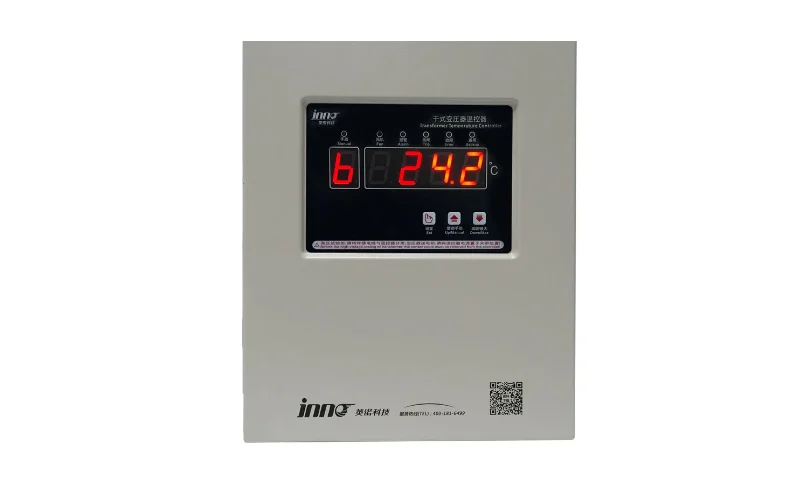
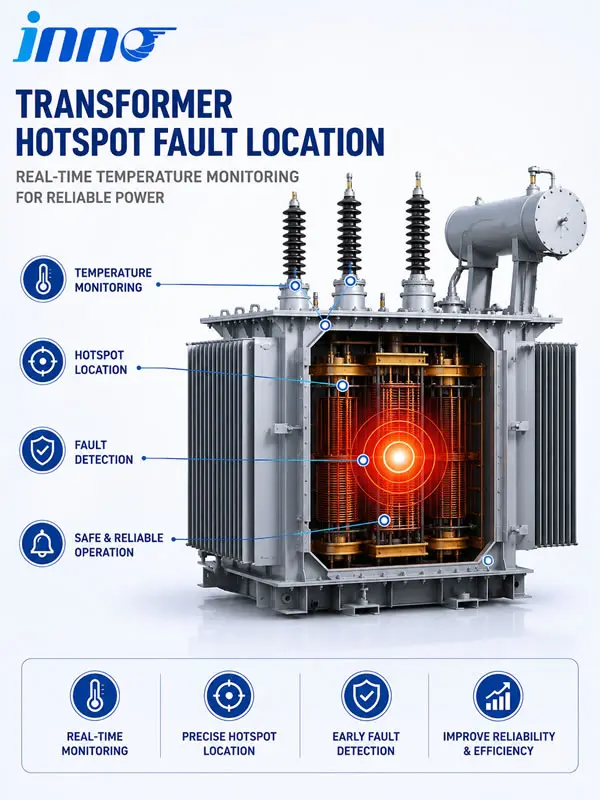
Transformer Partial Discharge Online Monitoring System Overview
The transformer partial discharge online monitoring system is used for continuous PD detection and transformer insulation condition assessment. It monitors partial discharge signals from transformer insulation, bushing areas, grounding paths and tank-mounted sensor positions while the transformer remains in operation.
The system is suitable for power transformers in substations, power plants, renewable energy stations and industrial facilities. It provides real-time data, alarm information and diagnostic patterns for maintenance teams that need to identify insulation defects before they become severe failures.
Partial Discharge Monitoring for Transformers
Partial discharge in transformer insulation is often an early sign of insulation aging, internal voids, surface discharge, loose contact, floating potential or other dielectric defects. Online partial discharge monitoring allows operators to observe PD activity continuously instead of relying only on periodic offline partial discharge testing.
| Monitoring Objective | What the System Helps Identify | Maintenance Value |
|---|---|---|
| Insulation condition | Internal discharge, surface discharge, corona and floating discharge signals | Early warning before insulation breakdown |
| PD activity trend | Discharge growth, phase concentration and abnormal pulse increase | Supports condition-based maintenance |
| Alarm status | PD level exceeding preset threshold | Helps operators respond before fault escalation |
| Transformer risk | Abnormal discharge patterns related to insulation defects | Improves transformer asset management |
Online Partial Discharge Monitoring System Architecture
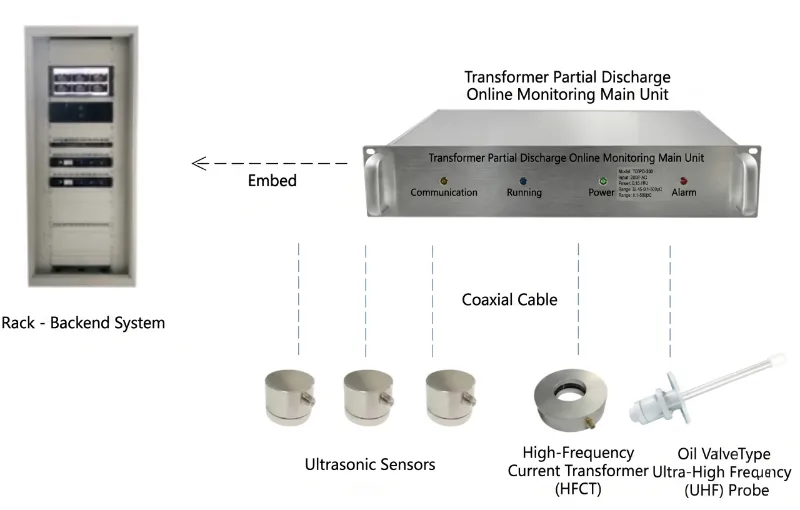
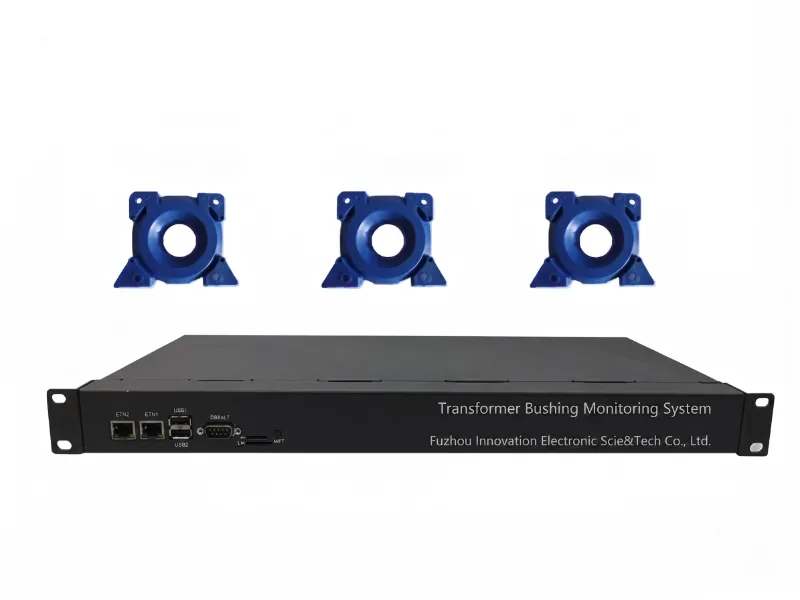
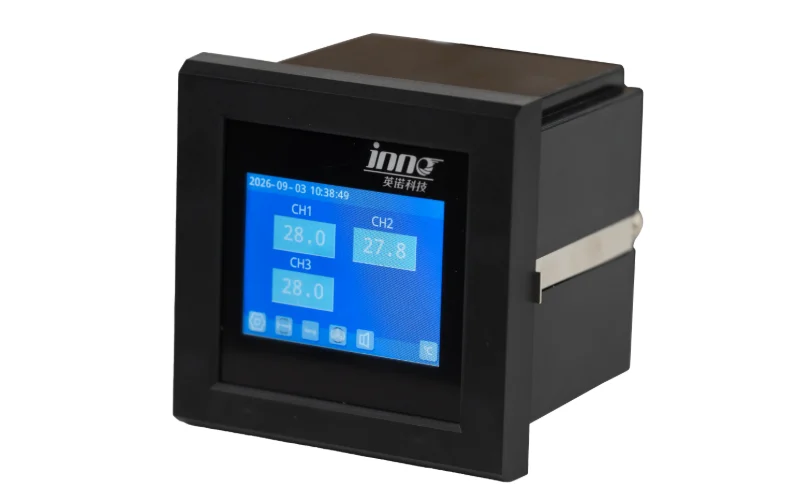
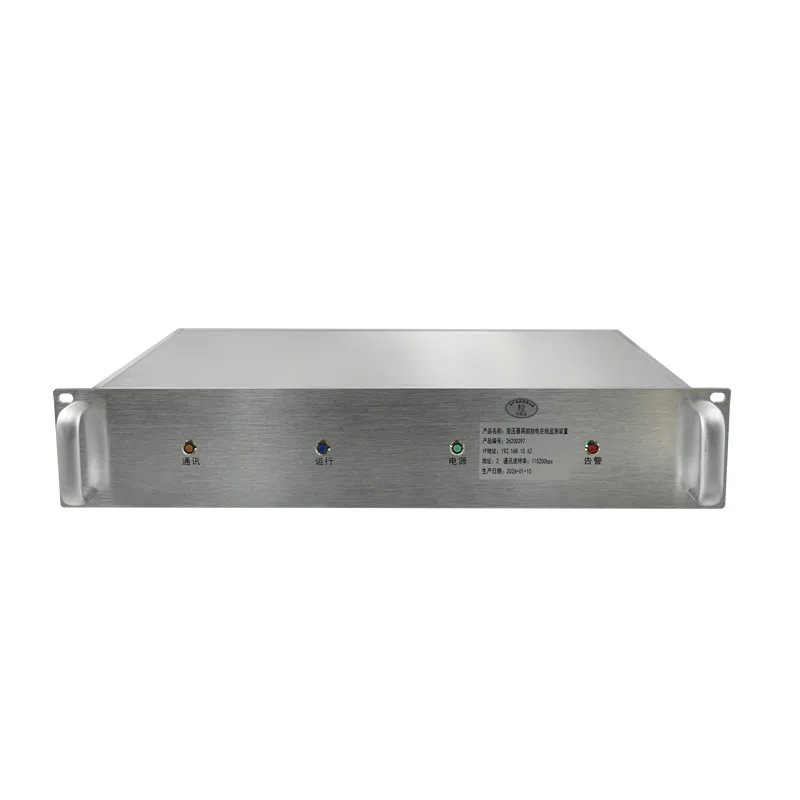
The system is built from partial discharge sensors, a PD monitoring host, communication interfaces and monitoring software. Sensors collect discharge-related signals from different positions. The host performs signal acquisition and processing. The software displays alarm data, PRPD patterns, historical curves and diagnostic information.
| System Part | Function | Typical Location |
|---|---|---|
| PD Sensors | Collect UHF, HFCT or ultrasonic partial discharge signals | Transformer tank, grounding cable, oil valve or selected monitoring point |
| PD Monitoring Host | Receives, samples and processes PD signals from sensor channels | Control cabinet, screen cabinet or monitoring panel |
| Monitoring Software | Displays PRPD, PRPS, trend curves, alarms and historical records | Control room computer or monitoring workstation |
| Communication Interface | Transfers PD data and alarm status to external systems | SCADA, substation monitoring platform or asset management system |
Partial Discharge Detection Sensors
 |
 |
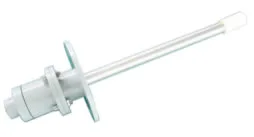 |
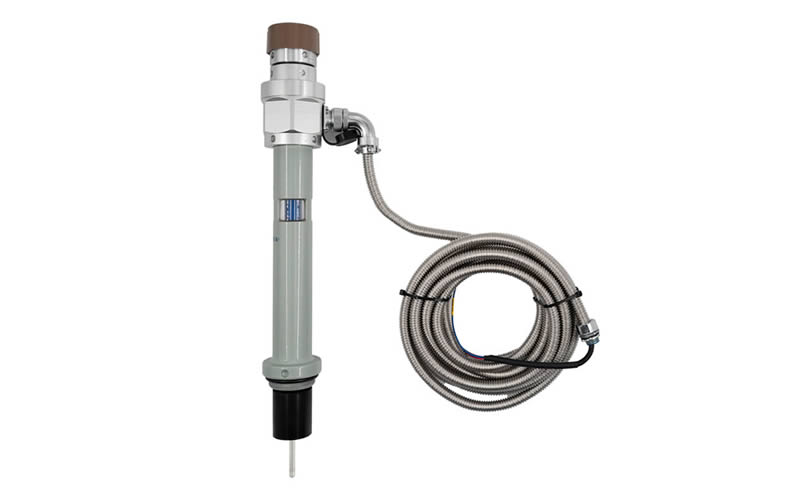
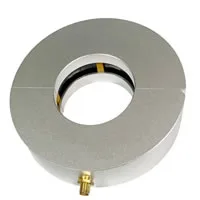
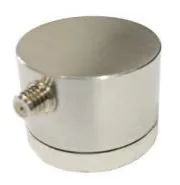
The transformer partial discharge monitoring system can use different sensor technologies according to the transformer structure, installation condition and monitoring objective. UHF, HFCT and ultrasonic sensors provide different signal paths for PD detection and cross-checking.
| Sensor Type | Monitoring Bandwidth | Installation Method | Main Purpose |
|---|---|---|---|
| UHF Partial Discharge Sensor | 300MHz to 3000MHz | Oil valve, plug-in port or transformer tank interface | Detects ultra-high frequency electromagnetic signals from internal PD activity |
| HFCT Partial Discharge Sensor | 100kHz to 50MHz | Clamp-on installation on grounding cable or bushing ground path | Detects high-frequency pulse current generated by partial discharge |
| Ultrasonic Partial Discharge Sensor | 20kHz to 200kHz | Magnetic or surface-mounted installation on transformer tank | Detects acoustic emission from PD activity inside the transformer |
PRPD Pattern Analysis and PD Diagnostics
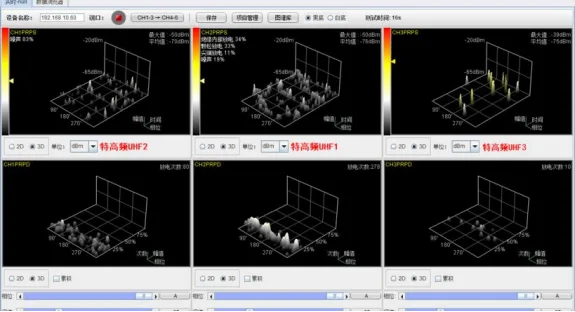
PRPD pattern analysis is used to show the relationship between discharge magnitude and phase position. It helps operators and diagnostic engineers evaluate whether the discharge behavior is random noise, corona discharge, surface discharge, internal discharge or another insulation-related PD pattern.
PRPD Display
The PRPD graph provides phase-resolved partial discharge information for pattern identification and severity evaluation.
PRPS Visualization
The PRPS view shows pulse sequence behavior over time, helping observe repetition, clustering and development trends.
Discharge Magnitude and Phase
The system records discharge magnitude and phase information to support insulation condition analysis and alarm setting.
Historical Trend Review
Trend curves help compare current PD activity with historical records, making it easier to identify abnormal growth.
Technical Specifications
| Specification Item | Standard / Optional Configuration |
|---|---|
| Product name | Transformer Partial Discharge Online Monitoring System |
| Monitoring object | Power transformer partial discharge and insulation condition |
| Detection content | Discharge magnitude, discharge phase, 3D PRPD pattern |
| Operating temperature range | -20°C to +125°C |
| Measurement range | -80dBm to -20dBm |
| Monitoring range | ≤20000pC |
| Transmission resistance | ≥12mV/mA |
| UHF sensor bandwidth | 300MHz to 3000MHz |
| HFCT sensor bandwidth | 100kHz to 50MHz |
| Ultrasonic sensor bandwidth | 20kHz to 200kHz |
| Sampling rate | 200MS/s |
| Channel configuration | 4 or 6 channels, configurable |
| Channel consistency | ≤0.5dBm |
| Protection rating | IP68 sensor protection option |
| Communication interface | RJ45 Ethernet, RS485 |
| Power supply | AC 90V to 240V, 50Hz to 60Hz |
| Host dimensions | 483mm × 89mm × 300mm, 2U rack mount |
| Installation method | Cabinet mount, panel mount, screen cabinet or convergence cabinet |
Partial Discharge Monitor Host Functions
| Function | Description | Use in Transformer Monitoring |
|---|---|---|
| Signal acquisition | Collects PD signals from selected sensor channels | Continuous transformer partial discharge monitoring |
| Noise suppression | Filters interference and supports signal identification | Improves monitoring reliability in substations |
| Alarm threshold setting | Allows PD alarm levels to be configured according to site requirements | Supports transformer fault warning |
| Data storage | Stores PD records for historical query and trend comparison | Supports maintenance review |
| Communication output | Transfers monitoring data to external systems | Connects with SCADA or asset monitoring platforms |
Online Monitoring vs Partial Discharge Test on Transformer
A partial discharge test on transformer is usually performed during factory testing, commissioning or planned maintenance. It provides test results at a specific time. Online partial discharge monitoring focuses on continuous condition tracking during transformer operation.
| Item | Online Partial Discharge Monitoring | Offline Partial Discharge Testing |
|---|---|---|
| Purpose | Continuous PD trend and alarm monitoring | Periodic test or acceptance evaluation |
| Operating status | Transformer remains in service | Usually arranged during test window or shutdown condition |
| Data value | Long-term trend, alarm and pattern development | Single-time test result or diagnostic snapshot |
| Best use | Critical transformer asset monitoring | Factory testing, commissioning or periodic inspection |
Applications of Transformer Partial Discharge Monitoring
Power Transformer Partial Discharge Monitoring
The system is used for online insulation condition monitoring of large oil-filled power transformers in substations and power plants.
Substation Transformer Monitoring
Continuous PD monitoring helps operation teams identify abnormal discharge activity in important transformer assets.
Industrial Transformer Condition Monitoring
Industrial plants can use the system to reduce unplanned downtime related to transformer insulation faults.
Transformer Bushing and Grounding Path Monitoring
HFCT sensors can be installed on grounding paths to detect high-frequency pulse signals related to PD activity.
Transformer Oil Insulation Monitoring
UHF and ultrasonic sensors can support internal PD detection for transformer oil-paper insulation systems.
How to Select a Transformer Partial Discharge Monitoring System
| Selection Item | What to Confirm |
|---|---|
| Transformer type | Oil-filled transformer, dry-type transformer or special transformer asset |
| Monitoring objective | Insulation warning, PD trend analysis, bushing monitoring or fault diagnosis |
| Sensor method | UHF, HFCT, ultrasonic or combined sensor configuration |
| Channel quantity | 4-channel, 6-channel or project-specific configuration |
| Installation position | Tank surface, oil valve, bushing grounding path, core ground or cabinet location |
| Communication requirement | Local software, Ethernet, RS485, SCADA or asset monitoring platform connection |
Recommended Project Information
| Required Information | Example |
|---|---|
| Transformer rating | Voltage level, capacity, oil-filled or dry-type structure |
| Installation environment | Substation, power plant, industrial site or renewable energy station |
| Sensor access | Oil valve access, tank surface access, grounding cable access or cabinet route |
| Monitoring channels | Number of UHF, HFCT and ultrasonic sensor points |
| Output requirement | Local monitoring software, RJ45 Ethernet, RS485 or SCADA integration |
| Alarm requirement | Alarm threshold, event records, trend display and diagnostic report requirement |
Frequently Asked Questions
What is a transformer partial discharge online monitoring system?
It is a monitoring system that continuously detects partial discharge signals in transformers and provides data for insulation condition assessment.
What sensors are used for transformer partial discharge monitoring?
The system can use UHF sensors, HFCT sensors and ultrasonic sensors according to transformer structure and monitoring requirements.
What is the difference between online monitoring and partial discharge testing?
Online monitoring provides continuous PD trend data during transformer operation. Partial discharge testing usually provides a test result at a specific time.
Can the system show PRPD patterns?
Yes. PRPD and PRPS displays can be used for discharge pattern analysis and PD diagnostic review.
Can it connect to SCADA?
Yes. The monitoring host can be configured with RJ45 Ethernet and RS485 interfaces for external monitoring system integration.
Where are the sensors installed?
Typical positions include transformer tank surface, oil valve port, grounding cable, bushing grounding path and selected cabinet routes.
What information is needed before selection?
Transformer type, sensor access, monitoring channel quantity, installation environment, communication requirement and alarm logic should be confirmed.
Transformer Partial Discharge Online Monitoring System for Insulation Fault Warning
The transformer partial discharge online monitoring system provides continuous PD detection, PRPD analysis, alarm output and communication integration for transformer insulation condition monitoring. It is suitable for power transformers in substations, power plants and industrial electrical systems where early insulation fault warning and long-term asset monitoring are required.