

التحليل الرقمي عبر الإنترنت (DGA) مقابل أخذ العينات الدورية للزيت: أيهما أفضل لرصد حالة المحولات؟
发布时间:6 سبتمبر 2026 الساعة 16:13:20
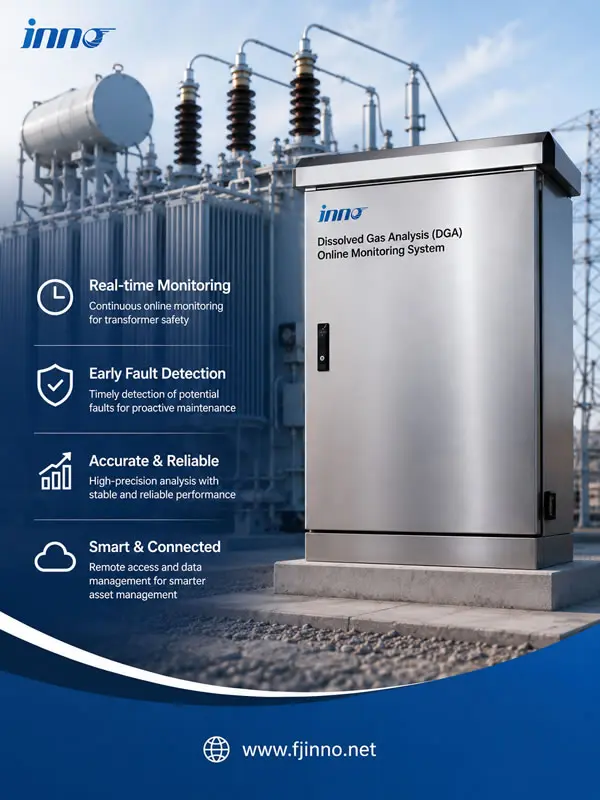
Power transformers are among the most expensive and critical assets in any electrical grid, substation, or industrial power network. A single unplanned transformer failure can trigger extended outages, costly emergency repairs, and serious safety hazards. This is why online dissolved gas analysis (DGA) monitoring has become a cornerstone of modern transformer health monitoring and predictive maintenance strategy. An online DGA monitoring system for transformer oil continuously analyzes the gases dissolved in insulating oil, giving engineers real-time visibility into the internal condition of oil-filled transformers — long before a fault becomes catastrophic.
In this guide, we explain how online DGA monitors work, which fault gases they detect, why continuous monitoring outperforms traditional lab-based oil sampling, and what to look for when selecting a multi-gas online transformer monitoring solution for your substation or power plant.
What Is Dissolved Gas Analysis (DGA)?
Dissolved gas analysis, or DGA, is a diagnostic technique used to assess the internal condition of oil-immersed transformers, reactors, and other high-voltage equipment. When a transformer experiences internal stress — such as partial discharge, electrical arcing, or thermal overheating — the insulating paper and mineral oil break down chemically. This decomposition releases specific fault gases into the transformer oil, including:
- Hydrogen (H2) — associated with partial discharge and corona activity
- Methane (CH4) و Ethane (C2H6) — indicators of low-to-medium temperature thermal faults
- Ethylene (C2H4) — a marker of higher-temperature thermal faults
- Acetylene (C2H2) — a strong indicator of high-energy arcing or severe electrical faults
- أول أكسيد الكربون (CO) و Carbon Dioxide (CO2) — signs of cellulose/paper insulation degradation
By measuring the concentration and ratio of these dissolved gases, engineers can identify the type of fault occurring inside a transformer — whether it's a thermal fault, an electrical fault, or normal aging — often well before the transformer shows any external symptoms.
Why Online DGA Monitoring Instead of Manual Oil Sampling?
Traditionally, dissolved gas analysis was performed by manually drawing an oil sample from the transformer and sending it to a laboratory for gas chromatography testing. While lab-based DGA testing remains accurate, it has several practical limitations:
- Sampling is typically performed only every few months or annually, leaving long blind spots between tests
- Fast-developing faults (such as arcing or partial discharge) can escalate to failure within days or weeks — far quicker than a scheduled sampling interval can catch
- Manual sampling introduces the risk of moisture ingress, sample contamination, and human error
- Lab turnaround time delays diagnosis and corrective action
و online DGA monitoring system solves these problems by installing a permanent, in-situ multi-gas sensor directly on the transformer, continuously measuring dissolved gas concentrations in real time — often at intervals ranging from minutes to hours. This shift from periodic offline testing to continuous condition-based monitoring is central to modern transformer asset management and smart grid monitoring strategies.
How Does an Online DGA Monitor Work?
Most online dissolved gas analysis systems use one of the following core sensing technologies:
1. Photoacoustic Spectroscopy (PAS)
Photoacoustic sensors use infrared light absorption to detect multiple gas species simultaneously with high sensitivity, making them well suited for multi-gas online DGA monitors that need to track hydrogen, methane, acetylene, ethylene, and other fault gases in a single unit.
2. Gas Chromatography (Online GC)
Online gas chromatography replicates laboratory-grade separation and detection of individual dissolved gases directly at the transformer, offering high accuracy comparable to offline lab DGA testing, but with continuous, automated sampling.
3. Micro-Gas Sensor Arrays / Semiconductor Sensors
Compact solid-state gas sensor arrays are often used in single-gas or dual-gas hydrogen monitors, providing a cost-effective early-warning solution for smaller or less critical transformers.
Once dissolved gas concentrations are extracted from the oil via a membrane or vacuum degassing unit, the analyzer measures individual gas levels, calculates key diagnostic ratios, and transmits the data — via Modbus, IEC 61850, SCADA, or cloud/IoT platforms — to a substation control room or remote monitoring center for trend analysis and alarm management.
Key Diagnostic Methods Used in Online DGA Interpretation
Raw gas concentration data alone isn't enough — meaningful fault diagnosis relies on internationally recognized interpretation methods, including:
- IEEE C57.104 — U.S. standard guide for interpreting dissolved gases in mineral oil-immersed transformers
- IEC 60599 — international standard for DGA interpretation using gas ratio methods
- Rogers Ratio Method — classifies faults based on ratios of key gas pairs
- Duval Triangle Method — a graphical technique widely used to distinguish between thermal faults, partial discharge, and arcing faults
- Key Gas Method — identifies dominant gases associated with specific fault types
A high-quality online DGA monitoring system should apply these standardized algorithms automatically, generating fault-type alerts and trend reports rather than raw numbers alone — reducing the burden on maintenance engineers and supporting faster, standards-based decision-making.
Benefits of an Online DGA Monitoring System for Transformer Oil
- Early fault detection: Identify incipient faults such as partial discharge, overheating, or arcing at an early stage, before insulation failure occurs
- Continuous condition-based maintenance: Shift from time-based to condition-based maintenance schedules, reducing unnecessary outages and lowering maintenance costs
- Reduced unplanned downtime: Real-time alarms allow operators to schedule interventions proactively instead of reacting to catastrophic failures
- Extended transformer service life: Early intervention limits insulation degradation and slows overall aging of the transformer
- Remote and unattended monitoring: Ideal for substations, renewable energy sites, offshore platforms, and remote installations where frequent manual inspection is impractical
- Historical trend analysis: Continuous data logging enables long-term trend visualization, helping distinguish sudden fault development from slow, normal aging
- Improved grid reliability and safety: Reduces risk of transformer explosion, oil fire, and cascading outages across the power network
Key Features to Look for in an Online DGA Monitoring System
When evaluating an online multi-gas transformer oil monitor for procurement, consider the following technical and practical criteria:
- Number of gases monitored: Single-gas (hydrogen only) monitors offer basic early warning, while multi-gas systems (7–9 key fault gases plus moisture) provide comprehensive diagnostic coverage
- Measurement accuracy and repeatability: Compare against IEEE C57.104 / IEC 60599 accuracy benchmarks and cross-validate against offline lab DGA results
- Moisture-in-oil monitoring: Many systems integrate moisture and relative humidity sensors alongside gas sensors, since water content strongly affects insulation aging and dielectric strength
- Communication protocols: Look for Modbus RTU/TCP, IEC 61850, DNP3, or cloud/IoT connectivity for SCADA and remote monitoring platform integration
- Explosion-proof / hazardous area certification: Essential for installations near energized equipment and oil-filled apparatus
- Maintenance requirements: Oil-free or membrane-based sampling systems with long calibration intervals reduce lifecycle maintenance costs
- Environmental durability: IP65/IP66-rated enclosures and wide operating temperature ranges for outdoor substation environments
- Built-in diagnostic software: Automated fault-type classification (Duval Triangle, Rogers Ratio, IEC ratio methods) with historical trend graphs and alarm thresholds
- Certifications and quality standards: ISO 9001 manufacturing quality management, CE marking, and compliance with relevant IEC/IEEE transformer monitoring standards
التطبيقات النموذجية
Online dissolved gas analysis monitoring systems are widely deployed across:
- Power utility substations and transmission transformers
- Generator step-up (GSU) transformers at power plants
- Industrial and manufacturing plant power transformers
- Renewable energy installations, including wind farm and solar farm step-up transformers
- Railway and traction power transformers
- Oil and gas facility electrical infrastructure
- Data centers and critical-load facilities requiring high power reliability
In each of these environments, the underlying goal is the same: protect a high-value, hard-to-replace asset by catching insulation and electrical faults early through continuous transformer oil analysis, rather than relying solely on periodic manual testing.
Online DGA vs. Traditional Lab Testing: A Practical Comparison
Rather than viewing online DGA monitoring and laboratory oil testing as competing approaches, most experienced transformer engineers treat them as complementary. Online multi-gas monitors provide continuous, real-time surveillance and immediate alarm capability, while periodic laboratory analysis — including furan analysis, dielectric breakdown voltage, and power factor testing — offers a broader diagnostic picture of overall oil and insulation condition. A well-designed transformer condition monitoring program typically combines:
- Continuous online DGA monitoring for real-time fault detection
- Periodic offline laboratory testing for comprehensive oil quality assessment
- Routine visual inspection and thermal imaging for external condition checks
- Data-driven asset health scoring to prioritize maintenance budgets across a transformer fleet
الأسئلة الشائعة
What gases indicate a transformer fault?
The primary fault gases tracked in dissolved gas analysis are hydrogen, methane, ethane, ethylene, acetylene, carbon monoxide, and carbon dioxide. Elevated acetylene levels, in particular, are a strong warning sign of high-energy arcing inside the transformer.
How often does an online DGA monitor take measurements?
Most online multi-gas DGA monitors measure dissolved gas concentrations automatically at intervals ranging from every 15 minutes to a few hours, depending on the system configuration and criticality of the monitored transformer.
Can online DGA monitoring replace laboratory oil testing?
Online DGA monitoring significantly reduces the risk of missed faults between lab testing intervals, but it is generally used alongside, rather than as a full replacement for, periodic laboratory analysis, which can assess additional parameters such as furan content, oil acidity, and dielectric strength.
Is online DGA monitoring suitable for older transformers?
Yes. Online DGA monitors can typically be retrofitted onto existing oil-filled transformers via the drain valve or an oil sampling port, making them suitable for both new installations and aging transformer fleets that require closer condition monitoring.
What standards govern DGA interpretation?
The two most widely referenced standards are IEEE C57.104 (used primarily in North America) and IEC 60599 (used internationally), both of which define gas concentration thresholds and ratio-based methods for fault classification.
Conclusion
As power grids grow more complex and transformer assets age, continuous, data-driven condition monitoring is no longer optional — it's essential risk management. An online dissolved gas analysis monitoring system for transformer oil gives utilities, industrial plants, and power generation facilities the real-time visibility needed to catch developing faults early, extend transformer service life, and avoid costly unplanned outages. Combined with standards-based interpretation methods like IEEE C57.104, IEC 60599, and the Duval Triangle, a well-specified multi-gas online DGA monitor becomes a core component of any modern transformer health monitoring and predictive maintenance program.
If you're evaluating an online DGA monitoring solution for your substation, power plant, or industrial facility, our engineering team can help match the right multi-gas sensor configuration, communication protocol, and certification requirements to your specific transformer fleet and operating environment.