

What Is a Fiber Optic Temperature Measurement System?
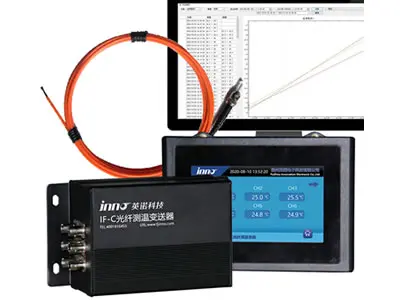
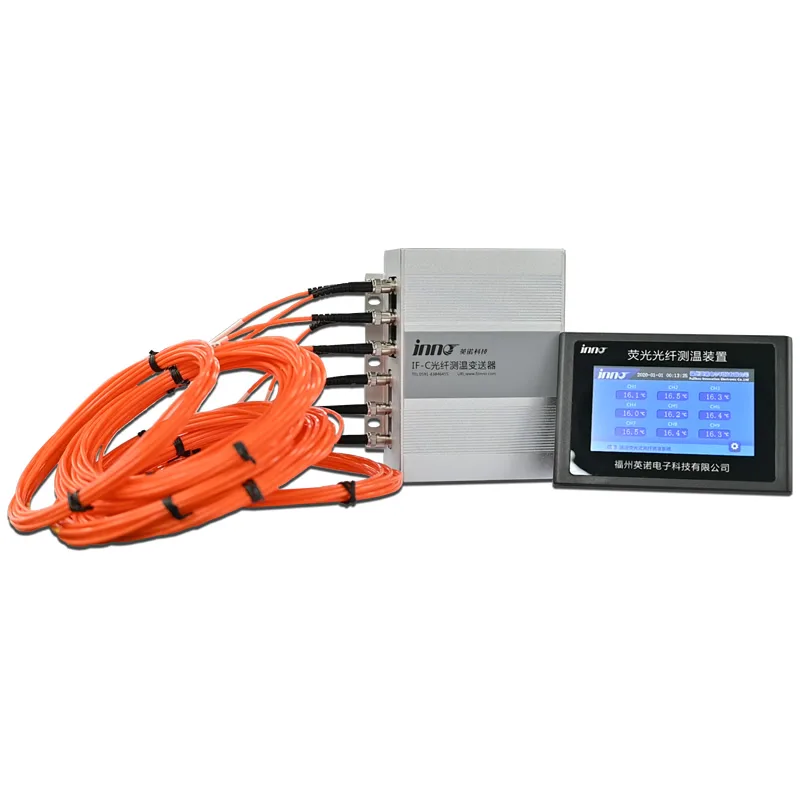
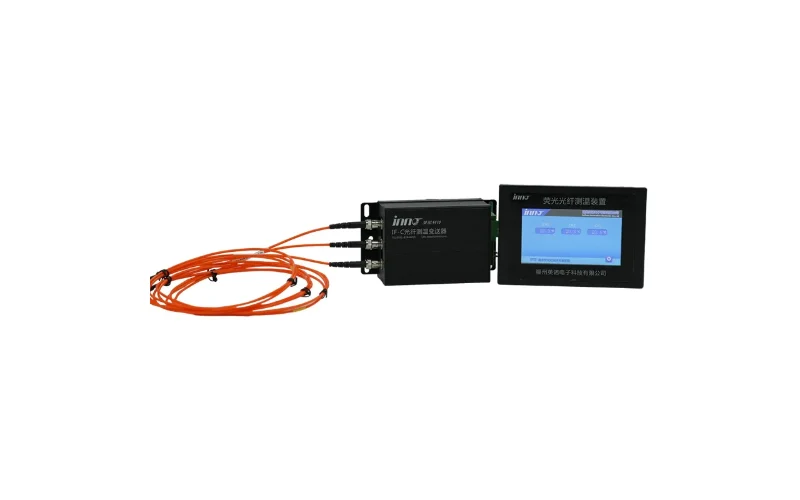
A sistema de medição de temperatura por fibra óptica is a complete temperature monitoring solution that uses optical temperature probes and a signal processing transmitter to measure temperature at one or multiple points. It is mainly used in electrical and industrial environments where high voltage, electromagnetic interference, compact installation space or insulation safety makes conventional electrical temperature sensors less suitable.
The system is not limited to one type of equipment. It can be configured for power distribution cabinets, transformer windings, busbar joints, cable terminals, generator windings, ring main units, GIS cabinets, industrial heating equipment, semiconductor equipment and other applications that require stable temperature data from difficult measuring points.
System Positioning
This product is suitable for projects requiring high-voltage temperature monitoring, multi-channel temperature measurement, electrical contact hotspot monitoring, transformer winding temperature monitoring, busbar temperature monitoring, cable terminal temperature monitoring or industrial optical temperature sensing.
Main Application Areas
| Application Area | Typical Measuring Points | System Purpose |
|---|---|---|
| Switchgear Temperature Monitoring | Circuit breaker contacts, busbar joints, cable terminals, disconnectors | Detect local overheating in medium-voltage and high-voltage cabinets |
| Monitoramento da temperatura do transformador | Dry-type transformer coils, oil-immersed transformer windings, internal hotspots | Monitor winding temperature and hotspot conditions |
| Busbar Temperature Monitoring | Copper bar joints, bolted connections, high-current contact points | Identify temperature rise caused by contact resistance |
| Cable Terminal Monitoring | Cable heads, cable plugs, cable joints, termination points | Monitor cable connection hotspots in compact spaces |
| Ring Main Unit Monitoring | RMU plug connections, cable connectors, insulated connection areas | Provide local temperature data for compact distribution equipment |
| GIS Cabinet Monitoring | Selected cabinet positions, support cabinets, internal connection points | Measure temperature in insulated or EMI-sensitive cabinet positions |
| Generator and Motor Monitoring | Stator, winding, collector ring, selected hotspot positions | Measure temperature in strong electromagnetic environments |
| Industrial Equipment Monitoring | Heating area, insulated point, remote measuring position, process hotspot | Support stable temperature measurement in harsh industrial sites |
Industry Solutions
Power Distribution Solution
For switchgear, ring main units and distribution cabinets, the system can monitor contacts, cable terminals and busbar joints. It helps operators identify abnormal temperature rise before it develops into insulation aging, connector failure or equipment shutdown.
Transformer Temperature Monitoring Solution
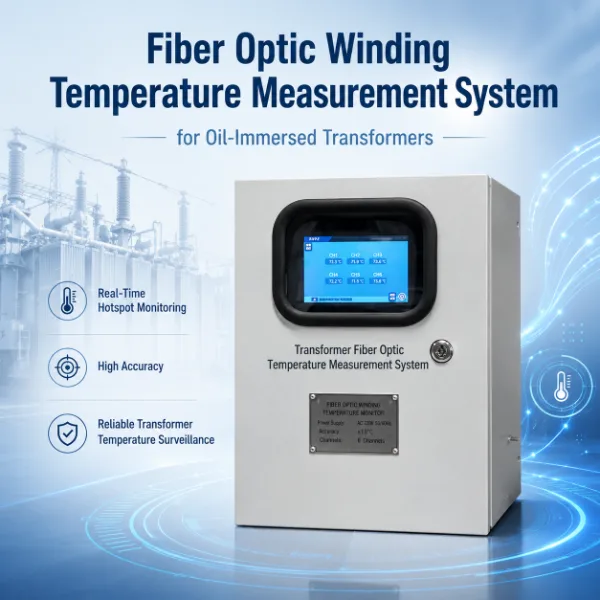
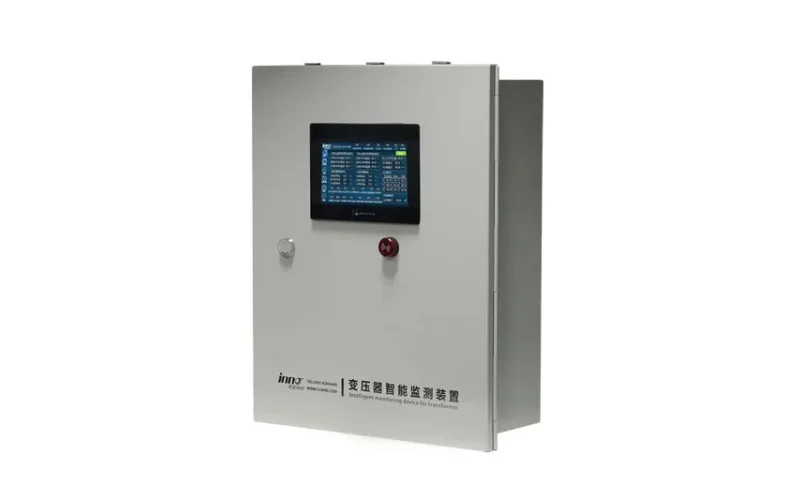
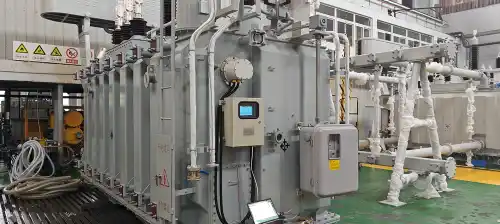
For dry-type and oil-immersed transformers, the system can be configured for winding temperature measurement, internal hotspot monitoring or multi-point thermal monitoring. It is suitable for transformer manufacturers, substations and industrial users that need direct temperature data from key thermal positions.
Generator and Motor Solution
For rotating machinery and strong electromagnetic environments, optical temperature measurement can be used where electrical sensors may be affected by interference. The system can be configured for stator, winding or selected hotspot positions.
Industrial Process Solution
For industrial equipment, the system can be used where the measuring point is remote, electrically isolated, difficult to access or affected by electromagnetic fields. Probe structure, fiber length and output method can be selected according to the project environment.
OEM Equipment Integration Solution
For equipment manufacturers, the system can be integrated into cabinets, control panels, monitoring devices or custom equipment. Channel quantity, transmitter structure, output interface and probe type can be selected according to the final equipment design.
Componentes do sistema
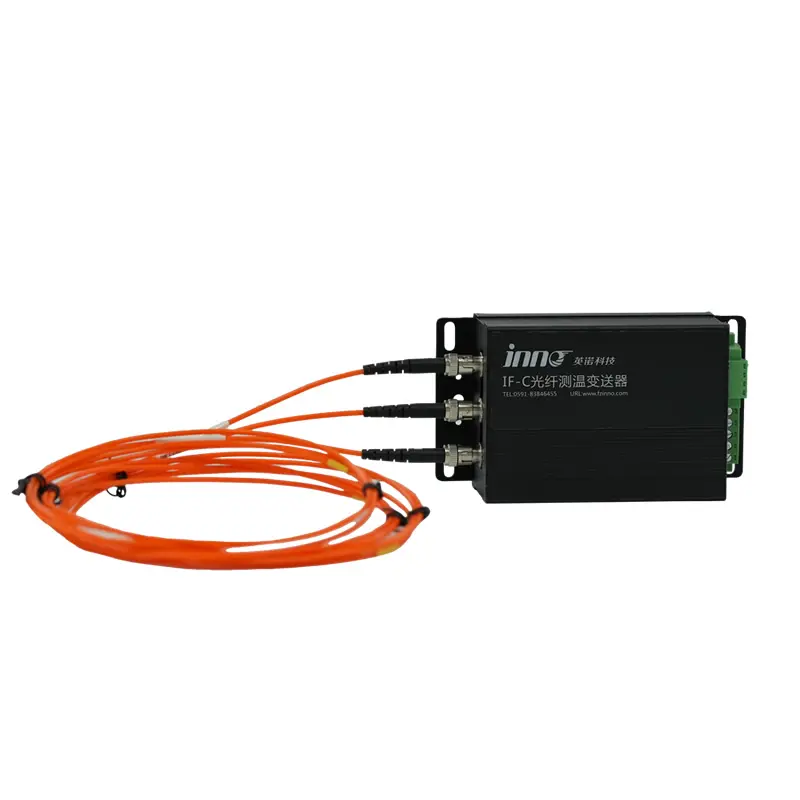
| Componente | Função | Typical Installation |
|---|---|---|
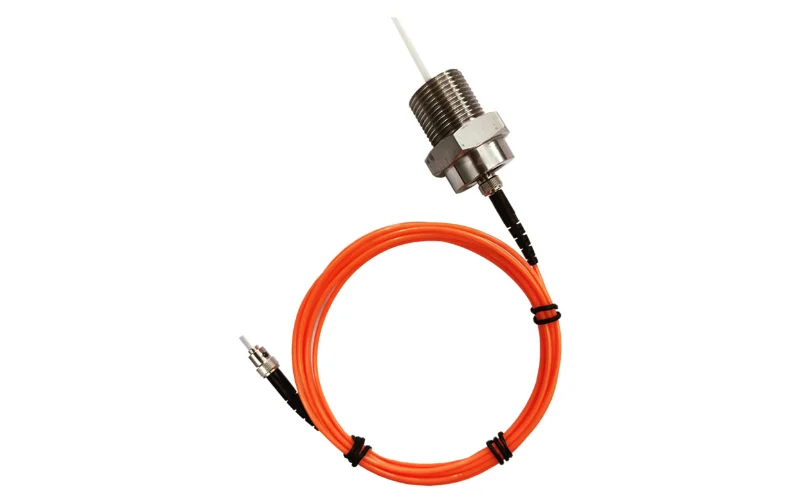
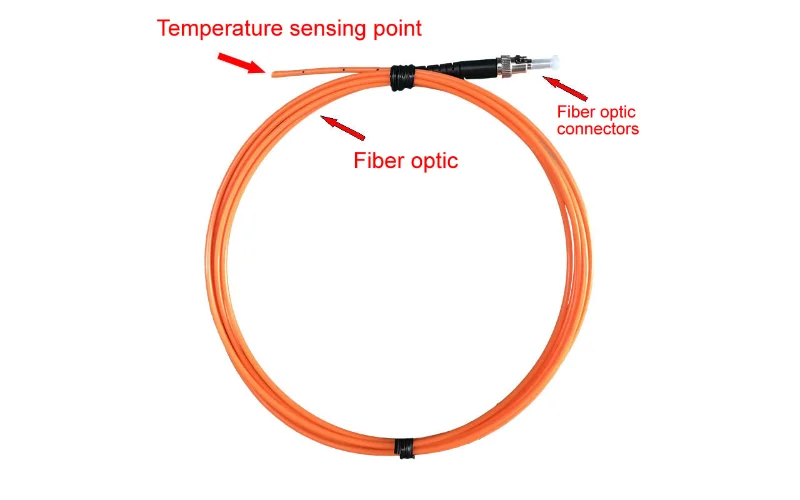
| Optical Temperature Probe | Measures temperature at the target point | Contact, winding, busbar joint, cable terminal or hotspot position |
| Optical Fiber Cable | Transmits optical signals between probe and transmitter | Inside cabinet, transformer, cable compartment or equipment enclosure |
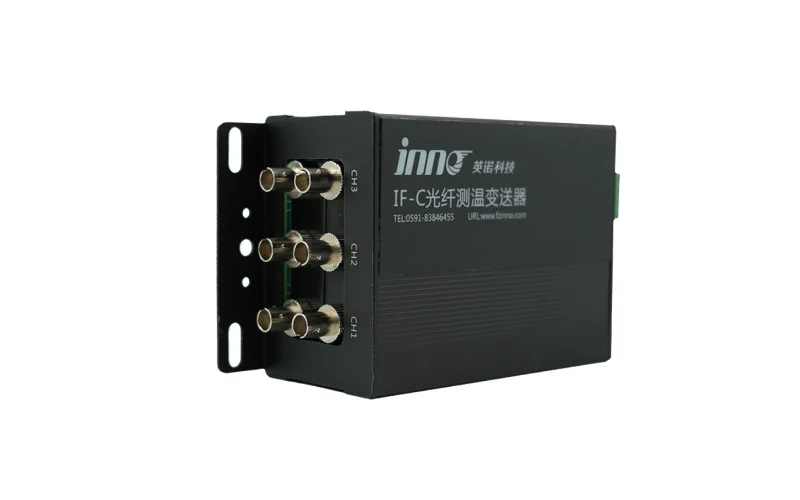
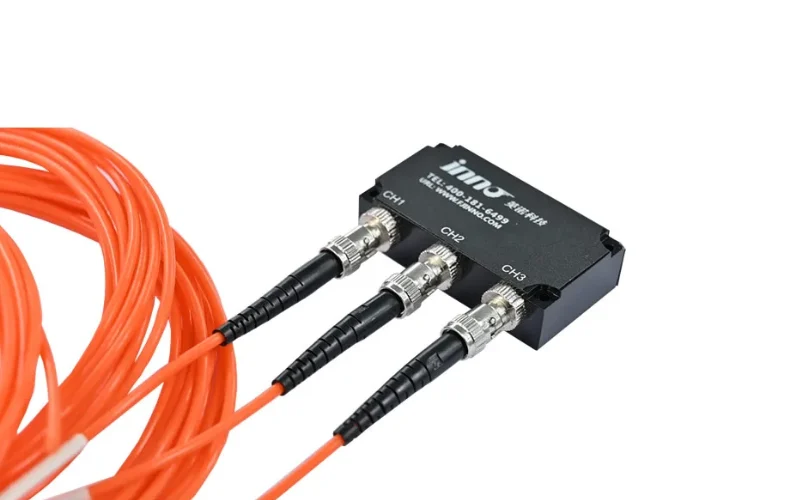
| Temperature Transmitter | Processes optical signal and converts it into temperature data | Panel, cabinet, DIN rail, control box or OEM device housing |
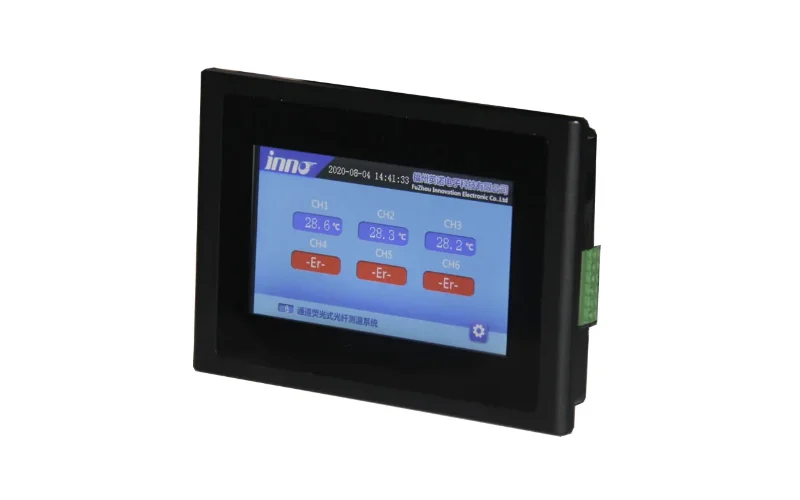
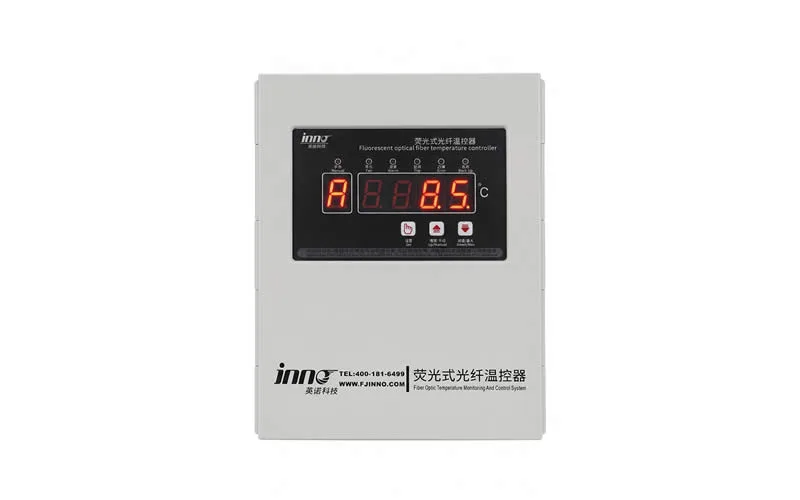
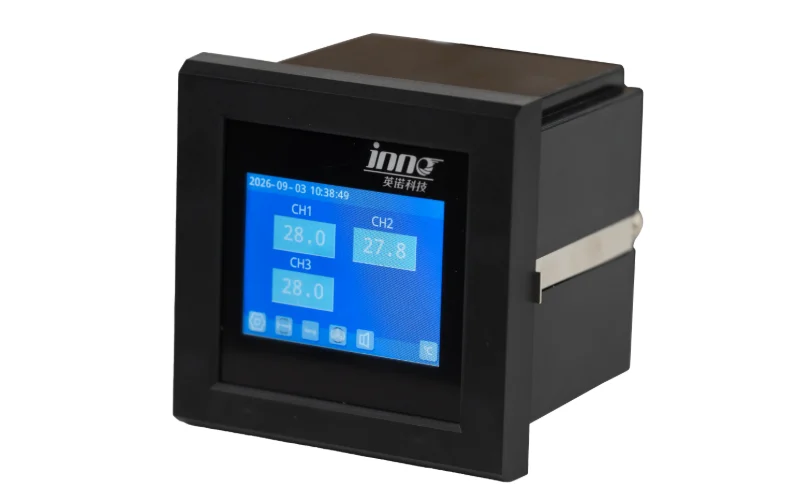
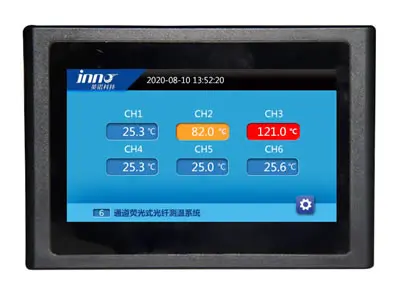
| Display Unit | Shows real-time temperature and alarm status | Cabinet panel, local operator panel or monitoring interface |
| Saída de alarme | Provides warning or protection signal | Cooling control, alarm relay, protection circuit or cabinet warning system |
| Interface de comunicação | Transfers data to external monitoring systems | PLC, SCADA, DCS, monitoring platform or local data acquisition system |
Especificações Técnicas
| Item da especificação | Configuração padrão / opcional |
|---|---|
| Nome do produto | Sistema de medição de temperatura por fibra óptica |
| Measurement type | Point-type optical temperature measurement |
| Faixa de temperatura | -40°C to +240°C, higher range customizable |
| Precisão | ±1°C standard, higher accuracy customizable |
| Resolução | 0,1 °C |
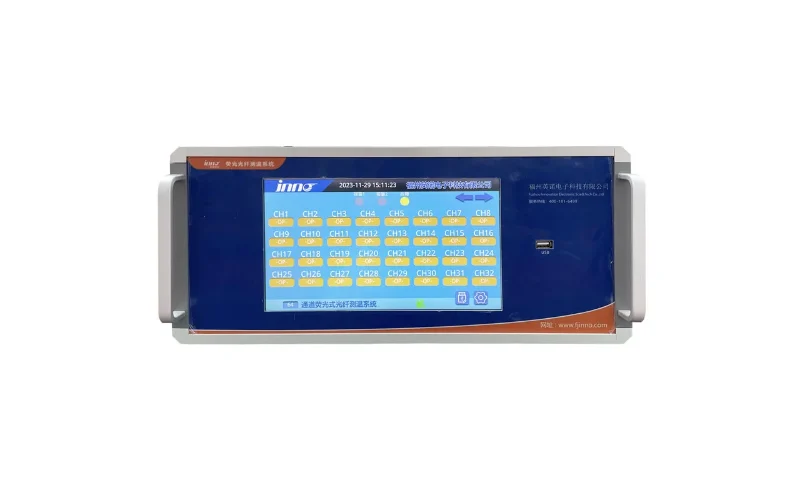
| Quantidade de canais | 1 to 64 channels, customizable |
| Probe type | Standard, compact, surface-mounted, armored, winding-installed or customized |
| Fiber type | Quartz optical fiber |
| Fiber length | Customizable according to project requirement |
| Probe diameter | 2.5 mm standard, smaller sizes customizable |
| High-voltage probe option | 100 kV class probe available |
| Fonte de alimentação | AC/DC 220V, other input options depending on device configuration |
| Interface de comunicação | RS485, Modbus communication interface |
| Analog output | 4-20mA optional output |
| Transmitter configuration | 1-8 channel, 9-16 channel or customized multi-channel configuration |
| Método de instalação | Panel mount, cabinet mount, DIN rail or project-specific installation |
| Typical applications | Switchgear, transformer, busbar, cable terminal, RMU, GIS, generator, motor and industrial equipment |
Transmitter Configuration Options
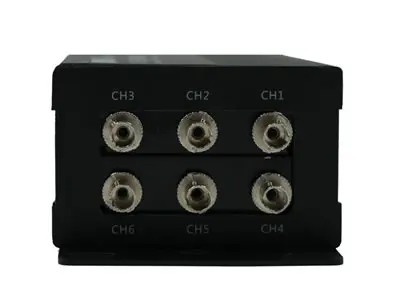
| Configuração | Suitable Scenario | Application Focus |
|---|---|---|
| 1-8 Channel Transmitter | Single cabinet, small switchgear, limited measuring points | Compact monitoring and simple panel installation |
| 9-16 Channel Transmitter | Transformer, switchgear group, RMU or medium-scale equipment | Multi-point temperature monitoring |
| Multi-Module System | Large equipment group, multi-cabinet system or plant-level project | Expandable monitoring network |
| Display Instrument | Cabinet front panel or local operator interface | Real-time display and alarm management |
| OEM Module | Equipment manufacturer or integrated monitoring product | Embedded optical temperature measurement function |
Solution Matching by Equipment Type
| Equipment Type | Recommended Probe Position | Recommended Configuration Focus |
|---|---|---|
| Medium-Voltage Switchgear | Contacts, busbar joints, cable terminals | Compact probes, local display, alarm output |
| Transformador imerso em óleo | Winding hotspot, internal support area, lead area | Insulated probe, oil-compatible structure, multi-point monitoring |
| Transformador do tipo seco | Coil hotspot, winding surface, internal thermal point | Winding-installed probe and cabinet transmitter |
| Busbar System | Copper bar joint, bolted connection, high-current contact | Surface-mounted probe and alarm threshold setting |
| Cable Terminal Compartment | Cable head, plug connector, termination point | Compact probe and narrow-space fiber routing |
| Generator or Motor | Stator, winding, selected hotspot position | EMI-immune measurement and remote monitoring output |
| Industrial Equipment | Insulated point, heating area, remote hotspot | Customized probe and communication integration |
System Architecture
Sensing Layer
The sensing layer includes optical temperature probes installed at critical temperature points. Probe structure is selected according to equipment type, installation space and thermal risk point.
Transmission Layer
The optical fiber connects the sensing point and the transmitter. It allows the measuring point to remain electrically isolated while the transmitter is installed in an accessible location.
Processing Layer
The transmitter processes temperature signals, manages channel data and provides alarm or communication output according to system configuration.
Output Layer
The system can provide local display, relay alarm, analog output or digital communication for different monitoring architectures.
Integration Layer
Temperature data can be connected to cabinet displays, PLC, SCADA, DCS or higher-level asset monitoring systems depending on the project design.
Key System Benefits
Wide Application Coverage
One system platform can be adapted for power distribution, transformer monitoring, rotating machinery, cable systems and industrial temperature monitoring.
Suitable for High-Voltage Environments
Optical sensing allows temperature measurement at locations where electrical sensors may require complex insulation design.
Strong EMI Resistance
The optical signal path is suitable for substations, cabinets, transformers, generators and other environments with strong electromagnetic fields.
Flexible Channel Configuration
The system can be configured from a small number of measuring points to larger multi-point monitoring projects.
Project-Based Probe Selection
Different probe structures can be matched with different equipment, including surface-mounted, compact, armored and winding-installed probes.
Easy Data Integration
The system can provide alarm and communication outputs for local monitoring, remote monitoring and equipment protection.
How to Select the Right Fiber Optic Temperature Measurement System
Confirm the Industry and Equipment
Identify whether the system is used for power distribution, transformer manufacturing, substation monitoring, industrial equipment, rotating machinery or OEM integration.
Confirm the Measuring Points
Define the number and location of the measuring points, such as contacts, windings, busbar joints, cable heads or machine hotspots.
Confirm Probe Type
Select the probe structure according to mechanical protection, insulation requirement, installation space and contact method.
Confirm Channel Quantity
Choose the transmitter configuration according to the number of temperature points and future expansion requirements.
Confirmar requisito de saída
Decide whether the project requires local display, alarm output, analog signal, RS485 Modbus or connection to a monitoring platform.
Confirm Installation Method
Check whether the transmitter will be installed on a panel, inside a cabinet, on a DIN rail or inside an OEM device enclosure.
Recommended Information for System Selection
| Informações obrigatórias | Exemplo |
|---|---|
| Setor | Power distribution, transformer, generator, industrial equipment, OEM integration |
| Tipo de equipamento | Switchgear, transformer, busbar, cable terminal, RMU, GIS, generator or motor |
| Measuring point | Contact, winding, busbar joint, cable head, plug, stator or surface hotspot |
| Number of points | Single point, 3 points, 6 points, 9 points, 16 points or customized |
| Probe structure | Standard, compact, surface-mounted, armored, winding-installed or customized |
| Transmitter location | Panel, cabinet, control box, equipment room or OEM device housing |
| Requisito de saída | Display, relay alarm, RS485 Modbus, 4-20mA or monitoring platform connection |
| Operating environment | High voltage, strong EMI, oil environment, narrow cabinet or industrial site |
Perguntas frequentes
What is a fiber optic temperature measurement system?
It is a temperature monitoring system that uses optical probes and a transmitter to measure one or multiple temperature points in electrical or industrial equipment.
Where can this system be used?
It can be used in switchgear, transformers, busbars, cable terminals, ring main units, GIS cabinets, generators, motors and industrial equipment.
What is the difference between the system and a sensor probe?
The sensor probe measures the target point. The system includes probes, transmitter, output interface, alarm function and communication integration.
Can the system support multi-point monitoring?
Yes. The system can be configured with different transmitter channels according to the number of measuring points.
Can different probe types be used in one project?
Yes. Different probe structures can be selected for different measuring positions within the same project.
Is the system suitable for high-voltage cabinets?
Yes. Optical temperature sensing is suitable for high-voltage cabinets because the measuring point can remain electrically isolated.
Can it be used for transformer monitoring?
Yes. It can be configured for dry-type transformer coils, oil-immersed transformer internal hotspots and transformer winding temperature monitoring.
Can it connect to SCADA or PLC?
Yes. With suitable communication configuration, temperature data can be connected to SCADA, PLC, DCS or other monitoring systems.
Can it provide alarm output?
Yes. Alarm output can be configured according to monitoring device and project requirement.
Quais informações são necessárias antes da seleção?
Equipment type, measuring point quantity, probe structure, transmitter location, output requirement and operating environment are usually required.
Fiber Optic Temperature Measurement System for Industrial and Power Equipment
The fiber optic temperature measurement system provides multi-point temperature monitoring for power distribution, transformer, busbar, cable terminal, generator, motor and industrial equipment applications. With flexible probe selection, channel configuration, alarm output and communication integration, it is suitable for projects that require stable temperature data from high-voltage, EMI-sensitive or difficult-to-access measuring points.