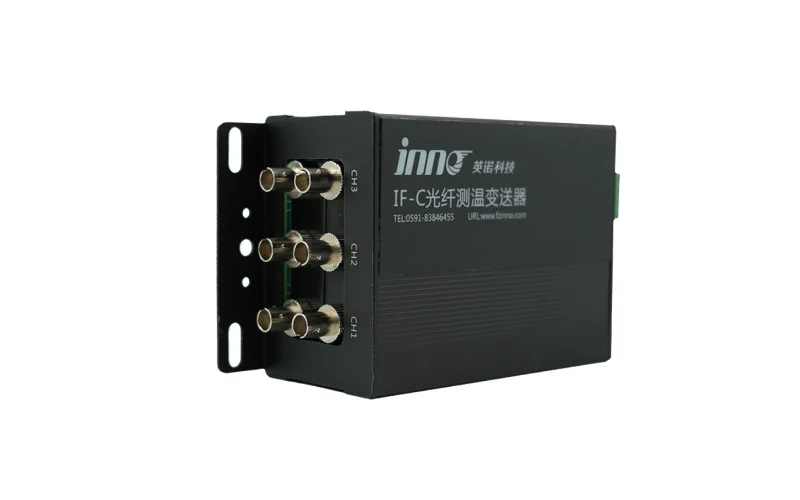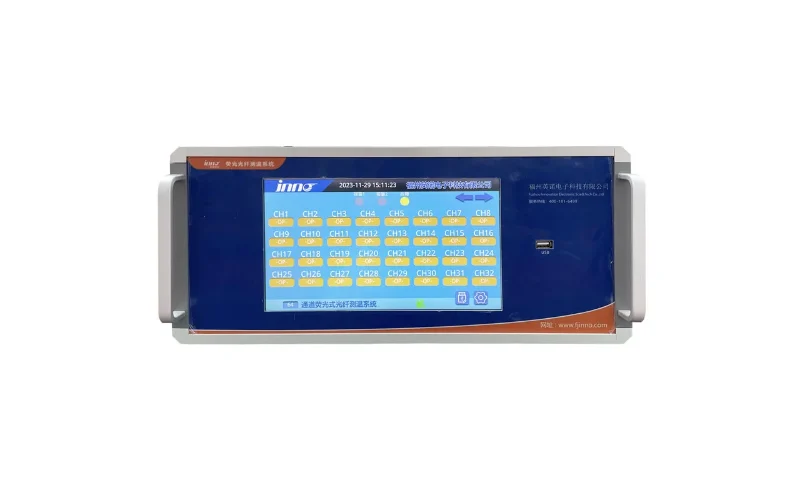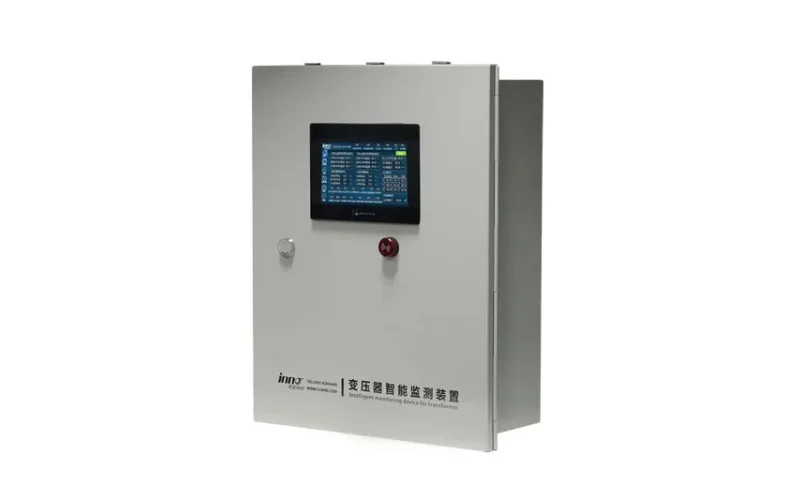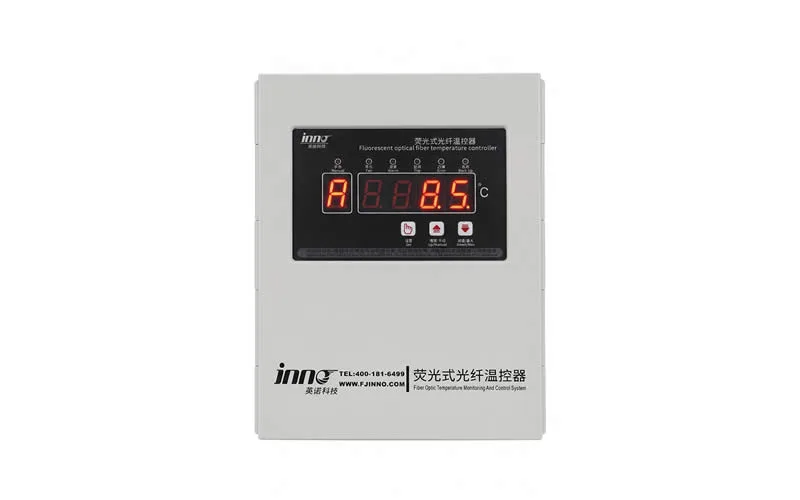
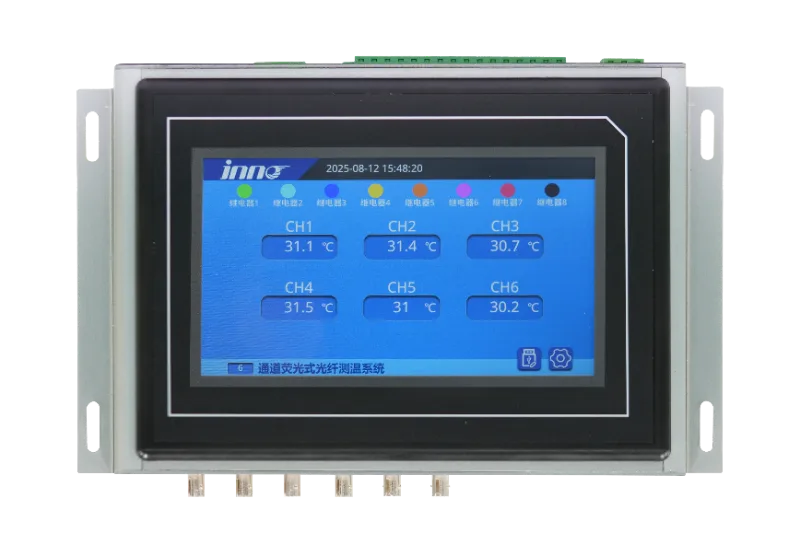
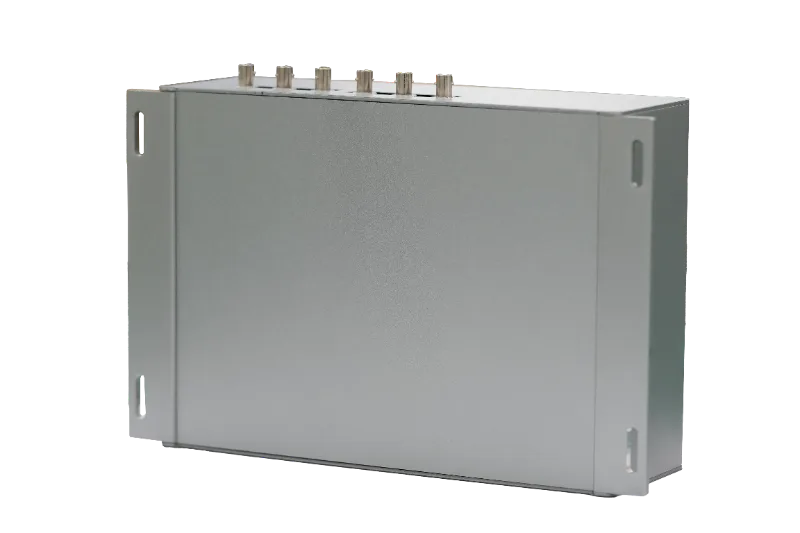
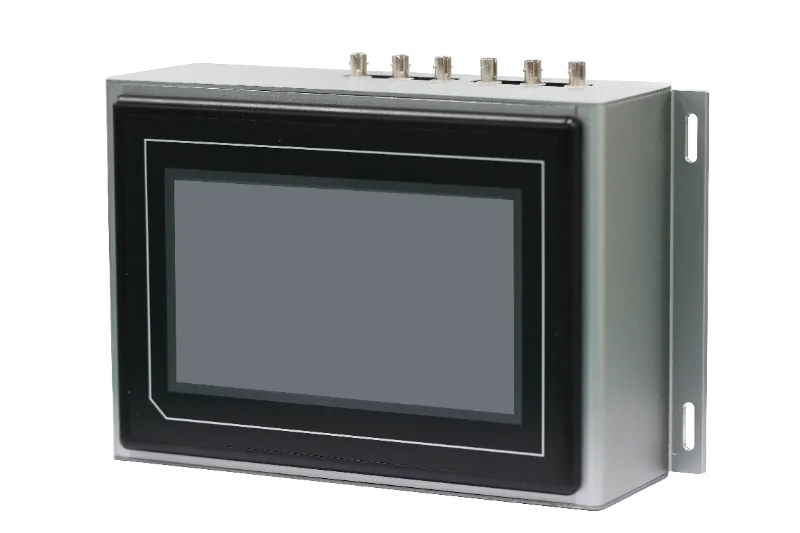

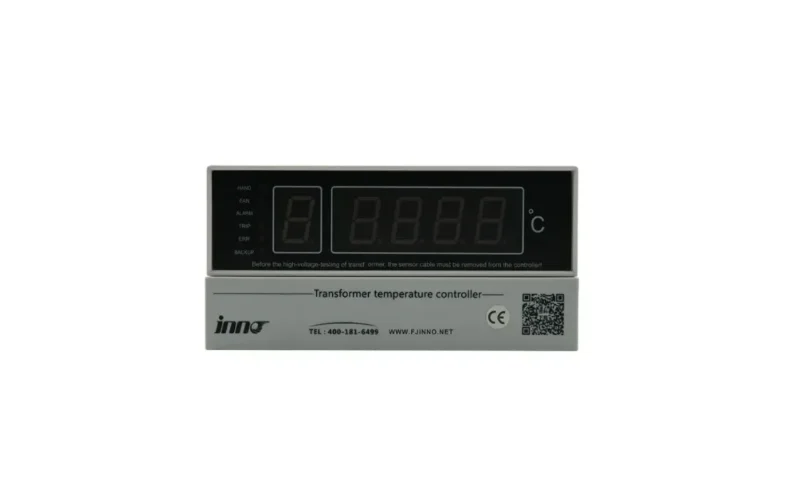
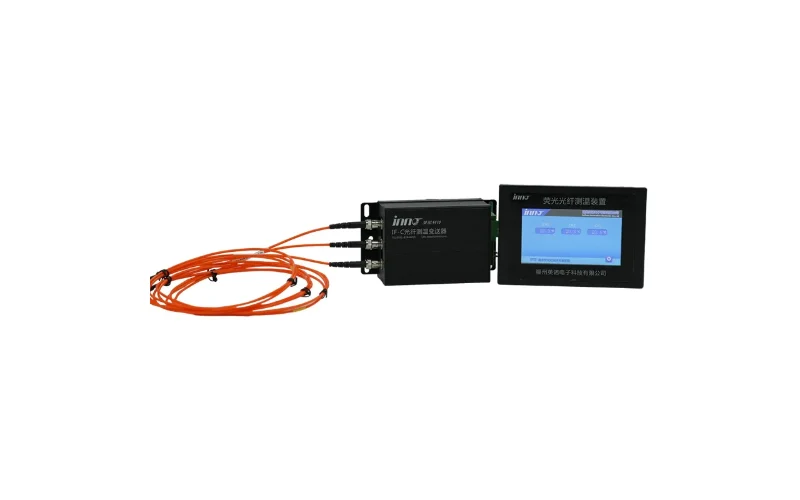
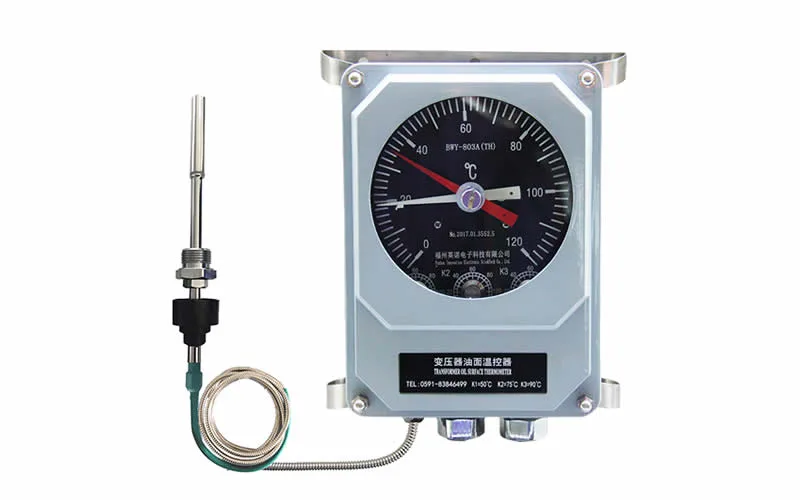


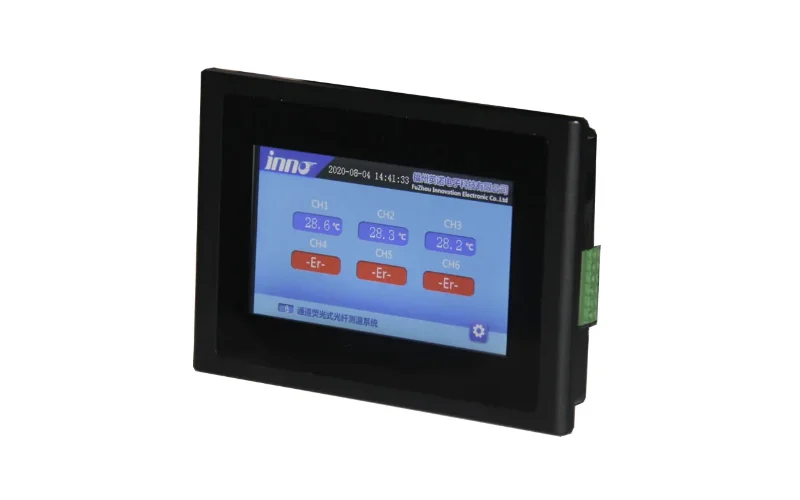
The INNOFZ fiber optic temperature display integrated host is a wall-mounted monitoring unit that combines fluorescent optical temperature demodulation with an on-board display and multi-protocol communication in a single enclosure. Built for high-voltage and strong electromagnetic interference environments, it is widely used for transformer winding monitoring, switchgear hot-spot detection, and other power equipment temperature applications where direct electrical sensing is unsafe or unreliable.
Principais recursos
- Integrated local display combined with the demodulation host — no separate display module required
- Fluorescent point-type optical sensing, electrically isolated from the measurement point for safe operation under high voltage
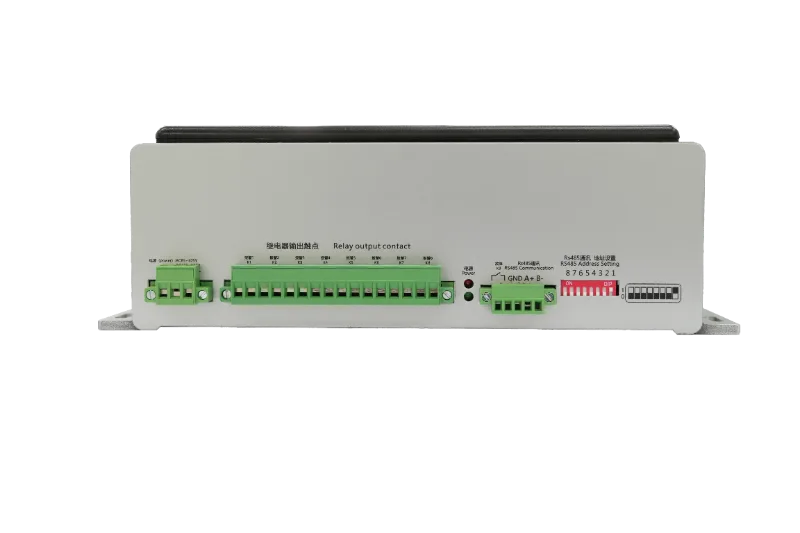
- Multiple communication options: RS485/Modbus-RTU, 4–20mA analog output, and Ethernet-based Modbus TCP
- Compatible with IEC61850 substation protocols through a protocol converter for direct integration into power system networks
- Relay dry-contact alarm outputs with independently configurable trigger thresholds, freely mapped to any monitored channel
- Wall-mounted enclosure with modular internal layout for straightforward installation and maintenance
How the Fluorescent Sensing System Works
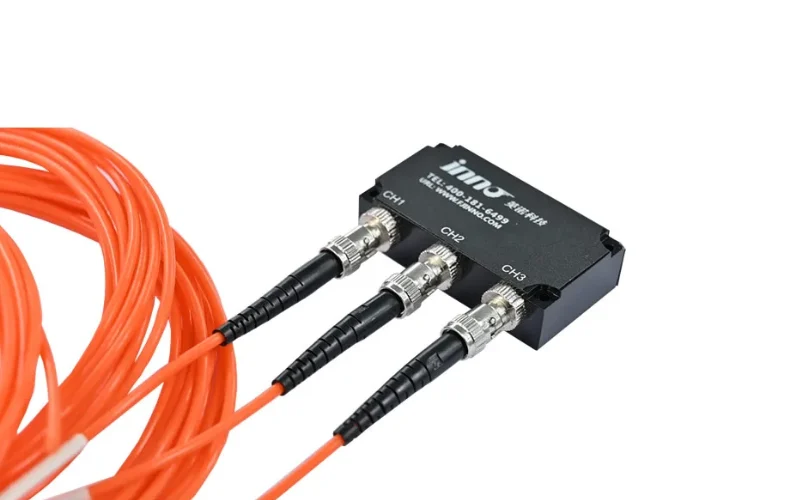
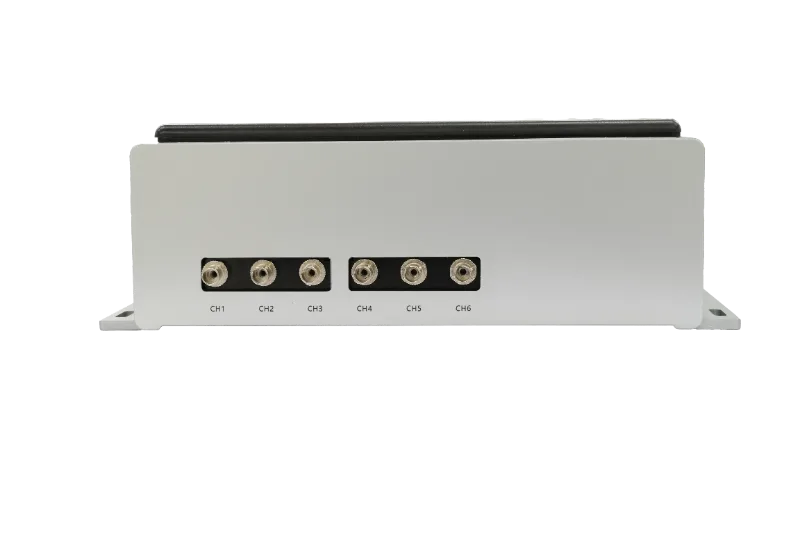
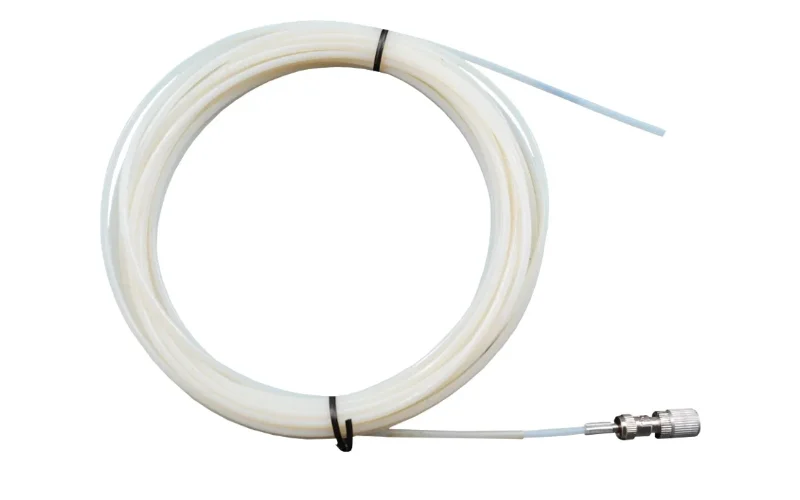
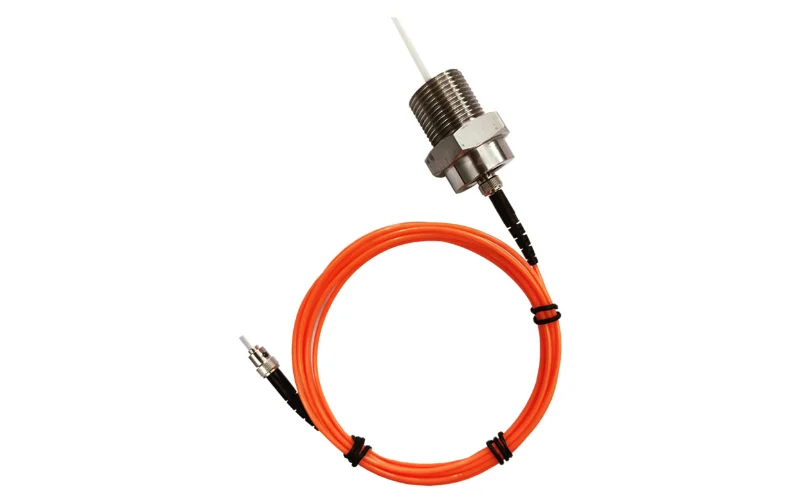
Each fiber optic probe consists of an ST connector, a quartz fiber optic cable, and a temperature-sensing tip containing rare-earth fluorescent material. The probe tip is attached directly to the surface of the monitored object. As temperature changes, the fluorescent material generates an optical signal that varies accordingly, which travels through the insulated fiber back to the host for demodulation into a precise digital temperature reading — with no electrical connection at the measurement point.
Aplicações
- Transformer winding hot-spot temperature monitoring (oil-immersed and dry-type)
- Switchgear contact and busbar temperature monitoring
- High-voltage equipment temperature monitoring in strong EMI environments
- Industrial process equipment requiring isolated, non-contact temperature feedback
Parâmetros técnicos
| Parâmetro | Especificações |
|---|---|
| Método de instalação | Wall-mounted |
| Dimensions | 256 × 158 × 75 mm (customizable) |
| Mounting Hole Spacing | 243 × 118 mm |
| Ambient Operating Temperature | -20°C to +65°C |
| Ambient Humidity | ≤95% (at 25°C) |
| Storage Temperature | -40 °C a +70 °C |
| Operating Voltage | 100–240 VAC |
| Faixa de medição | -40°C to 260.0°C (customizable) |
| Precisão da medição | ±1°C (customizable) |
| Resolução | 0,1 °C |
| Número de canais | 1–24 channels (customizable) |
| Fiber Type / Length | Quartz fiber, standard 5 m (customizable) |
| Diâmetro da sonda de fibra | 2.5 mm / 3 mm (customizable) |
| Tensão de resistência da sonda | 80 kV (20 cm withstand length) |
| Interface de comunicação | RS485/Modbus-RTU, 4–20mA, Modbus TCP (Ethernet) |
| Saída de alarme | 8 relay dry-contact outputs, independently configurable |
| Quality Certification | ISO9001:2015 |
| Test Standards | IEC61000-4, GB/T17626-2008 |
Personalização e Assistência Técnica
INNOFZ builds every display integrated host to order. Channel count, measurement range, accuracy, probe diameter, fiber length, enclosure dimensions, and communication protocol can all be adapted to fit specific transformer cabinets, switchgear panels, or industrial control systems. INNOFZ supports OEM/ODM cooperation, including private labeling and pre-configured units for panel builders and system integrators.
- Custom channel count from single-point up to large multi-point arrays
- Custom enclosure size and mounting layout for retrofit or new-build cabinets
- Protocol customization, including IEC61850 conversion for substation automation networks
- OEM/ODM and private-label manufacturing for panel and switchgear builders
- Pre-sales engineering consultation and after-sales technical support
Contact INNOFZ to discuss your installation requirements and request a tailored configuration.
Perguntas frequentes
What makes this host different from a standalone demodulator unit?
This model integrates the display directly into the demodulation host, so on-site personnel can read temperatures locally without a separate display module, while still supporting full remote communication for SCADA-level monitoring.
Can it be integrated into an existing substation automation network?
Yes. In addition to RS485/Modbus-RTU and 4–20mA analog output, the host supports Modbus TCP over Ethernet and can interface with IEC61850-based substation networks through a protocol converter.
How does the relay alarm function work?
The host provides multiple relay dry-contact outputs. Each relay's trigger threshold can be set independently, and any relay can be mapped to one or more monitored channels, allowing flexible alarm logic without external programming.
What if my project needs a different enclosure size or mounting style?
Enclosure dimensions, mounting hole spacing, and installation method can be customized — see the Customization & Service section above for the full range of adaptable options.