
Transformer Monitoring Solutions for Transformer Condition Monitoring and Health Assessment
Power transformers, distribution transformers, oil-immersed units, dry-type units, and traction transformers each face different thermal, insulation, and mechanical stresses. Our transformer condition monitoring system combines real-time monitoring with transformer health assessment to support predictive maintenance — built around fluorescent fiber optic temperature sensing as our core technology.
- Monitoring configurations organized by transformer type, not a one-size-fits-all approach
- Combines temperature, DGA, partial discharge, OLTC, and bushing monitoring as needed
- RS485 communication for SCADA and centralized monitoring integration
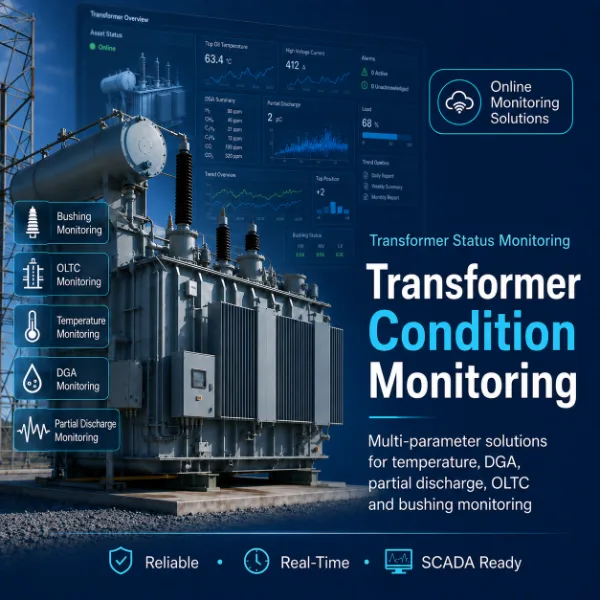
Transformer Condition Monitoring
Matched to power, distribution, oil-immersed, dry-type, and traction transformers
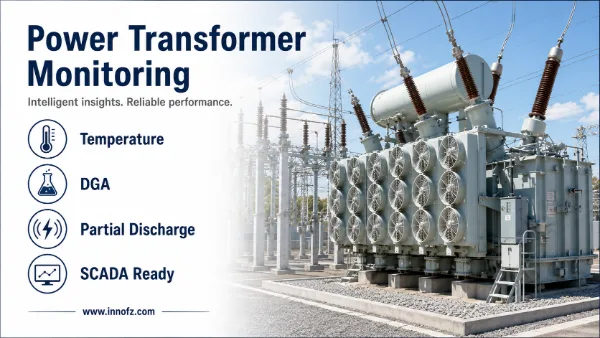
What Is Transformer Condition Monitoring?
Transformer condition monitoring is the continuous, online assessment of a transformer's key health indicators — such as winding temperature, oil condition, and insulation status — instead of relying solely on periodic manual inspections. Sensors installed on or near the transformer collect real-time data, which is then analyzed to detect early-stage faults before they escalate into failures.
- Replaces or supplements scheduled inspections with continuous, real-time data
- Covers multiple health parameters, from thermal to chemical to mechanical indicators
- Enables condition-based maintenance instead of fixed-interval maintenance schedules
- Integrates with SCADA or centralized monitoring platforms for remote visibility
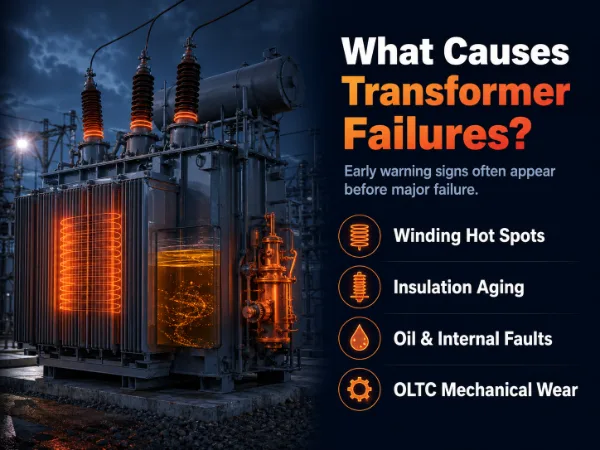
What Causes Transformer Failures?
Transformer failures rarely happen without warning signs. Thermal overload, insulation aging, internal arcing, and mechanical wear in components like the tap changer typically develop gradually — but without continuous transformer monitoring, these early indicators go unnoticed until a fault becomes severe.
- Winding hot-spots often form well before top-oil temperature shows any abnormal reading
- Insulation degradation from partial discharge activity can progress silently for extended periods
- Dissolved gases in transformer oil reveal internal faults before external symptoms appear
- Tap changer contact wear is a mechanical failure point separate from thermal or oil-related issues
Transformer Monitoring Solutions by Transformer Typee
Each transformer type experiences different thermal, mechanical, and insulation stresses. We match the transformer monitoring configuration to the equipment.
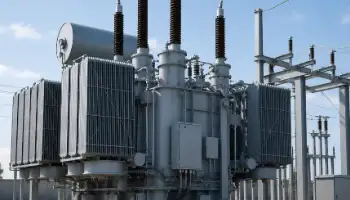
Giám sát máy biến áp điện
Giám sát theo thời gian thực các thông số chính để đảm bảo hoạt động ổn định của máy biến áp điện trong các hệ thống phát điện và truyền tải.
Tìm hiểu thêm →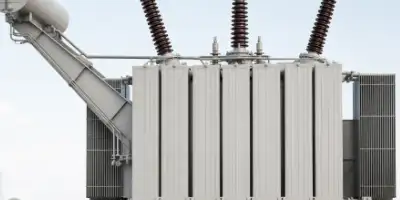
Giám sát máy biến áp ngâm dầu
Theo dõi nhiệt độ dầu, phân tích khí trong dầu (DGA), độ ẩm và các thông số khác để phát hiện sự cố sớm và đảm bảo hoạt động an toàn, ổn định.
Tìm hiểu thêm →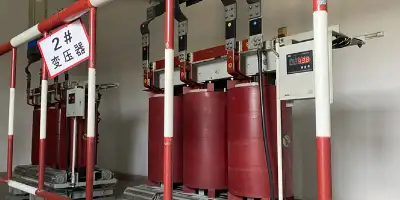
Giám sát nhiệt độ máy biến áp kiểu khô
Giám sát nhiệt độ tại nhiều điểm nhằm ngăn ngừa hiện tượng quá nhiệt và đảm bảo độ tin cậy của máy biến áp khô.
Tìm hiểu thêm →
Giám sát điểm nóng trên cuộn dây máy biến áp
Giám sát chính xác nhiệt độ tại các điểm nóng để tối ưu hóa việc quản lý tải và kéo dài tuổi thọ của máy biến áp.
Tìm hiểu thêm →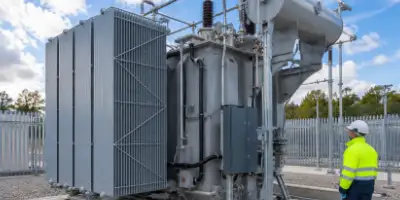
Giám sát cách điện máy biến áp
Theo dõi liên tục tình trạng cách điện để đánh giá mức độ lão hóa và ngăn ngừa sự cố cách điện.
Tìm hiểu thêm →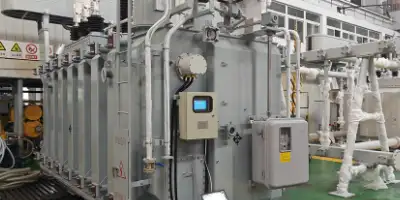
Giám sát máy biến áp tại trạm biến áp
Giám sát tích hợp đối với máy biến áp tại trạm biến áp nhằm nâng cao hiệu quả vận hành và độ tin cậy của hệ thống điện.
Tìm hiểu thêm →Transformer Condition Monitoring Parameters
Different transformer applications require different monitoring parameters. This matrix shows commonly used condition monitoring technologies for various transformer types.
| Transformer Type | Nhiệt độ | DGA | Phóng điện cục bộ | OLTC | Ống lót |
|---|---|---|---|---|---|
| Máy biến áp điện | ✓ | ✓ | ✓ | ✓ | ✓ |
| Oil-Immersed Transformer | ✓ | ✓ | ✓ | ✓ | ✓ |
| Dry-Type Transformer | ✓ | — | ✓ | — | — |
| Giám sát điểm nóng trên cuộn dây máy biến áp | ✓ | — | — | — | — |
| Giám sát cách điện máy biến áp | — | ✓ | ✓ | — | ✓ |
| Substation Transformer | ✓ | ✓ | ✓ | ✓ | ✓ |
Actual monitoring configuration depends on transformer design, voltage level, operating conditions and reliability requirements. Customized transformer monitoring solutions are available.
How Does Multi-Parameter Transformer Health Monitoring Improve Reliability?
A transformer failure rarely comes from a single cause. Thermal stress, insulation degradation, mechanical wear, and internal chemical changes often develop simultaneously, but at different rates. Relying on a single parameter — such as top-oil temperature alone — can miss faults developing elsewhere in the transformer. Combining multiple indicators supports a more complete transformer health monitoring and condition assessment strategy.
- Transformer temperature monitoring is one of the most important parameters in transformer condition monitoring. Winding hot spot temperature and thermal stress assessment help identify early signs of overload and insulation aging.
- DGA monitoring detects internal faults through gases dissolved in the oil, often before any temperature change is visible.
- Partial discharge monitoring catches insulation weaknesses that temperature and gas analysis alone cannot always detect.
- OLTC and bushing monitoring cover mechanical and high-voltage connection points separate from the main tank.
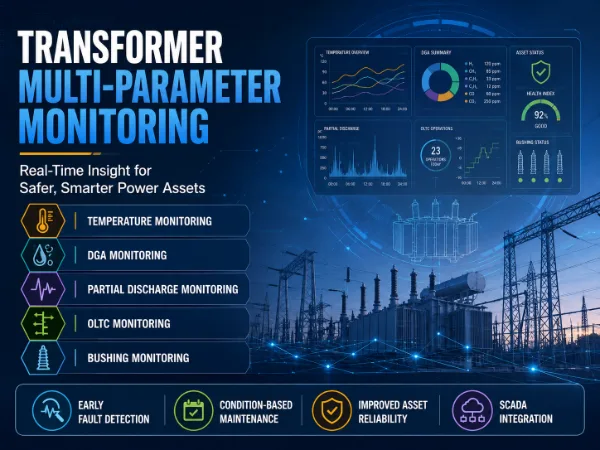
Transformer Condition Monitoring Technologies
The core technologies behind our transformer condition monitoring system, each addressing a different health indicator.
Giám sát nhiệt độ bằng sợi quang huỳnh quang
Measures winding hot-spot temperature directly, with complete immunity to electromagnetic interference in high-voltage environments.
Giám sát khí DGA của máy biến áp
Analyzes gases dissolved in transformer oil to detect internal faults before they escalate into visible symptoms.
Giám sát phóng điện cục bộ
Detects early-stage insulation weaknesses that other monitoring parameters cannot always identify.
OLTC Condition Monitoring
Tracks tap changer switching operations and contact wear to prevent mechanical failure points.
Transformer Bushing Monitoring
Continuously measures bushing capacitance and power factor to catch aging insulation in advance.
Các ứng dụng giám sát máy biến áp
How our transformer condition monitoring approach and transformer condition monitoring applications apply to specific equipment configurations and installation contexts.
Giám sát máy biến áp điện
How multi-parameter monitoring is configured for large generation and transmission transformers carrying the highest operational risk.
Tìm hiểu thêm →Giám sát máy biến áp ngâm dầu
How temperature and DGA monitoring work together to track internal oil chemistry changes over the transformer's service life.
Tìm hiểu thêm →Giám sát nhiệt độ máy biến áp kiểu khô
How multi-point winding temperature sensing is applied in fire-sensitive indoor installations without oil-based monitoring.
Tìm hiểu thêm →Giám sát điểm nóng trên cuộn dây máy biến áp
How direct fiber optic sensing at the winding hot-spot differs from estimated temperature calculations used in older systems.
Tìm hiểu thêm →Giám sát cách điện máy biến áp
How partial discharge detection is layered onto existing monitoring setups to track insulation condition over time.
Tìm hiểu thêm →Giám sát máy biến áp tại trạm biến áp
How combined temperature, DGA, and OLTC monitoring is deployed at substations to reduce cascading failure risk.
Tìm hiểu thêm →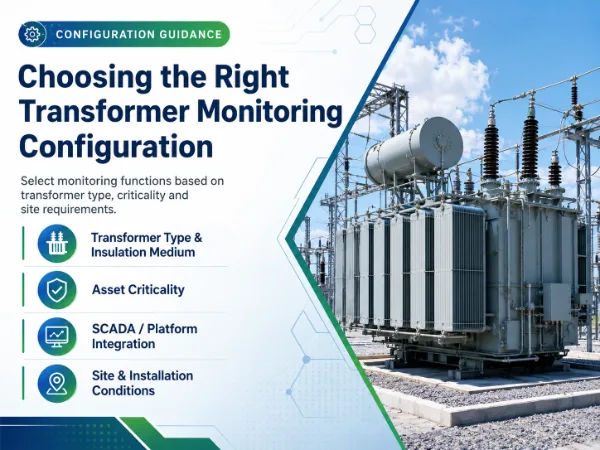
What Should You Consider When Choosing a Monitoring Configuration?
The right transformer monitoring setup depends on more than just equipment type. Criticality, installation environment, and existing infrastructure all influence which parameters make sense for your specific transformer.
- Transformer type and insulation medium (oil-immersed vs. dry-type)
- Criticality of the transformer to overall system reliability
- Whether SCADA or centralized monitoring integration is required
- Site environment, including high-voltage clearance and installation access
Transformer Monitoring Systems & Components
Browse the specific hardware behind each transformer monitoring parameter.
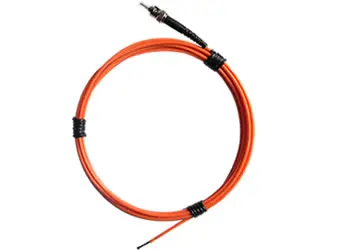
Cảm biến nhiệt độ sợi quang
The fluorescent fiber optic probe itself, installed directly on transformer windings.

Hệ thống giám sát nhiệt độ máy biến áp
Panel-mounted controller integrating multiple temperature inputs and alarm relays.
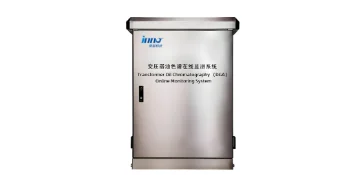
Hệ thống giám sát trực tuyến DGA
On-tank hardware analyzing dissolved gases in transformer oil in real time.
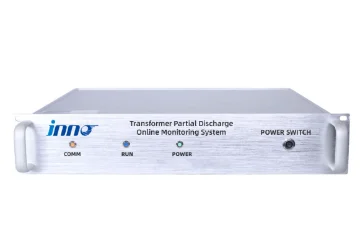
Hệ thống giám sát phóng điện cục bộ
Sensor and acquisition hardware capturing partial discharge signals.
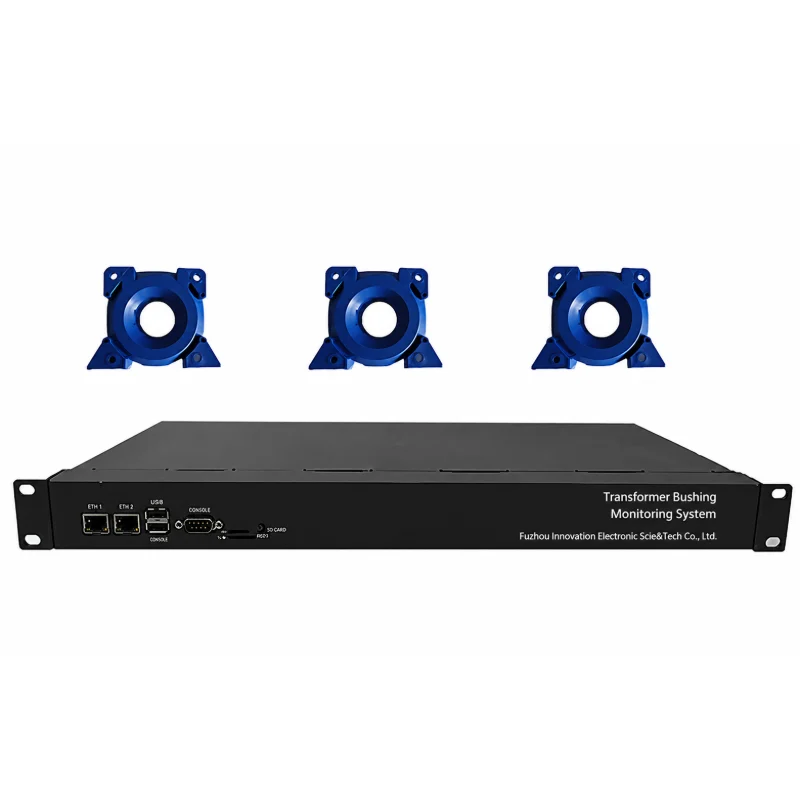
Hệ thống giám sát ống lót
Dedicated hardware measuring bushing capacitance and power factor.

Hệ thống giám sát OLTC của máy biến áp
Hardware monitoring unit mounted on the tap changer mechanism.
Transformer Condition Monitoring FAQ
Common questions specific to monitoring different transformer types.
What is transformer condition monitoring?
Transformer condition monitoring is the continuous assessment of transformer health using parameters such as temperature, DGA, partial discharge and mechanical condition indicators to detect potential failures before they occur.
What is the difference between transformer monitoring and transformer condition monitoring?
Transformer monitoring refers generally to tracking transformer operation, while transformer condition monitoring focuses on evaluating transformer health status and predicting potential failures through collected data.
Do different transformer types need different monitoring parameters?
Yes. For example, dry-type transformers typically only require temperature monitoring, while oil-immersed power transformers benefit from combined temperature, DGA, and partial discharge monitoring.
Which parameter should I prioritize if I can only monitor one?
Temperature monitoring is typically the most cost-effective starting point, as thermal stress is a common early indicator across nearly all transformer types.
Is DGA monitoring necessary for dry-type transformers?
No. DGA monitoring applies specifically to oil-filled transformers, since it analyzes gases dissolved in insulating oil. Dry-type transformers do not use oil and rely primarily on temperature monitoring.
Why do substation transformers often need multiple monitoring parameters?
Substation transformers serve as critical nodes in the distribution network, where a single fault can affect an entire regional area. Combining temperature, DGA, and OLTC monitoring provides broader fault coverage for these high-impact assets.
Can monitoring parameters be added later if my needs change?
In many cases, additional monitoring parameters can be incorporated into an existing setup. Please contact us with your current configuration for a compatibility assessment.
How do I know which transformer type applies to my equipment?
Transformer type is typically identified by insulation medium (oil-immersed or dry-type) and application (power generation, distribution, or substation). Contact us if you are unsure which category applies.
What is the difference between winding hot-spot monitoring and top-oil temperature monitoring?
Winding hot-spot monitoring measures temperature directly at the point of highest thermal stress inside the winding, while top-oil monitoring measures the oil temperature at the top of the tank, which is typically lower and less precise as an early warning indicator.
Does insulation monitoring require shutting down the transformer?
No. Partial discharge and insulation monitoring are designed to operate continuously during normal transformer operation, without requiring equipment shutdown.
Is multi-parameter monitoring more expensive than single-parameter monitoring?
Cost depends on the number of parameters and channels required. We work with you to prioritize parameters based on your transformer's criticality and budget.
Can I get a recommendation without knowing the exact transformer specifications?
Yes. Share what information you have — transformer type, application, and any known concerns — and our engineering team can provide an initial recommendation to refine further.
Not Sure Which Transformer Monitoring Configuration Fits Your Equipment?
Tell us your transformer type and application — our engineering team will recommend the right combination of monitoring parameters.