

Giám sát cách điện máy biến áp: Những yếu tố nào có thể được giám sát trực tuyến?
发布时间:Ngày 7 tháng 10 năm 2026, 15:54:38
- Measurable online: dissolved gases (DGA), moisture in oil, partial discharge (PD), bushing capacitance and tan delta, winding hot-spot temperature and core/clamp ground current.
- Estimated online: moisture in paper (calculated from oil data) and loss of life (calculated from hot-spot history). Both are indirect values.
- Offline only: insulation resistance and polarization index, winding power factor, FDS/DFR, SFRA, furan analysis, paper DP and laboratory oil quality tests.
- Best first sensors: online DGA with moisture, then fiber optic hot-spot sensing, then bushing monitoring, then PD and core ground current.
- Practical rule: online data detects change early and continuously, while offline tests confirm alarms and supply accurate baselines. Both are needed.
Mục lục
- 1. Insulation System Components: Winding Paper, Pressboard, Oil, Bushing Cores and Cast Resin
- 2. Insulation Aging Stresses and the Online Sensors That Track Them
- 3. Online vs Offline Indicator Table: DGA Monitor, Moisture Sensor, PD Sensor and FDS Tester
- 4. Online DGA Monitor: Dissolved Gas Signatures of Oil and Paper Faults
- 5. Online Moisture-in-Oil Sensor: Relative Saturation and Paper Moisture Estimates
- 6. Partial Discharge Sensors: UHF Antenna, HFCT, Bushing Tap Coupler and Acoustic Probe
- 7. Bushing Tap Adapter: Capacitance and Tan Delta Monitoring
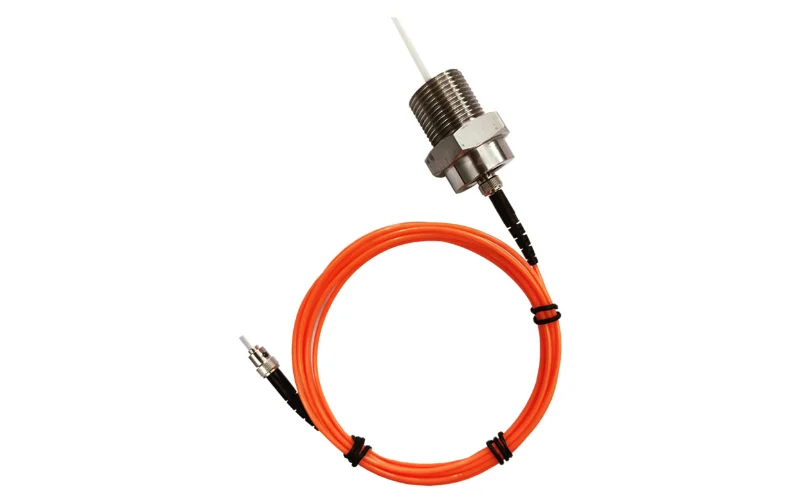
- 8. Fiber Optic Temperature Sensor: Winding Hot-Spot and Thermal Aging Rate
- 9. Clamp-On Current Sensor: Core and Clamp Ground Current Monitoring
- 10. Oil Level Transmitter, Pressure Sensor, OLTC Monitor and Surge Recorder
- 11. Offline Test Equipment: Insulation Tester, FDS/DFR Analyzer, SFRA Set and Furan Lab Analysis
- 12. Dry-Type Insulation Monitoring: Temperature Controller, Humidity Sensor and PD Detector
- 13. Priority Matrix: DGA Monitor vs Hot-Spot Sensor vs Bushing Monitor vs PD System
- 14. FAQ: Transformer Insulation Monitoring Questions
1. Insulation System Components: Winding Paper, Pressboard, Oil, Bushing Cores and Cast Resin

Six parts of an oil-immersed insulation system
Copper and steel rarely wear out. Paper, pressboard, oil and resin age continuously from the day of energization, and their failure usually ends in a short circuit, an internal arc and a long outage.
- Conductor insulation: paper wrapped around winding conductors, separating turns and discs.
- Major insulation: pressboard barriers, spacers and oil ducts between windings, and between windings and the core or tank.
- Insulating oil: fills every gap, impregnates the paper and carries heat away.
- Bushing insulation: oil-impregnated or resin-impregnated paper condenser cores that carry conductors through the tank wall.
- Tap changer insulation: insulation inside the OLTC selector and diverter.
- Core insulation: laminations and the insulation between the core and its clamping structure.
Dry-type units replace oil and paper with cast resin or vacuum-pressure-impregnated (VPI) insulation, and air handles cooling. Monitoring principles stay similar, but parameters change, as covered in section 12.
2. Insulation Aging Stresses and the Online Sensors That Track Them
Stress and indicator reference
| Stress | Effect on Insulation | Online Indicators |
|---|---|---|
| Thermal | Breaks cellulose chains, reduces paper strength | Hot-spot temperature, CO and CO₂, loss-of-life calculation |
| Độ ẩm | Speeds up aging, lowers dielectric strength, risk of bubbles | Moisture in oil, estimated moisture in paper |
| Oxygen and oxidation | Forms acids and sludge, accelerates paper aging | Mostly laboratory tests, some indirect signs from DGA |
| Electrical | PD erodes insulation, leading to tracking and breakdown | PD monitor, hydrogen and acetylene in DGA, bushing tan delta |
| Mechanical | Short-circuit forces and vibration loosen or crack insulation | Limited online options, mainly offline tests |
Stresses act together
Heat accelerates moisture release, moisture lowers the discharge threshold, and discharge produces gas and more heat. Reviewing transformer failure modes and detection methods shows how these chains end in actual failures.
3. Online vs Offline Indicator Table: DGA Monitor, Moisture Sensor, PD Sensor and FDS Tester
Quick answer table
| Indicator | Giám sát trực tuyến | What It Reveals |
|---|---|---|
| Khí hòa tan | Yes, mature | Active faults in oil and paper: PD, arcing, overheating |
| Moisture in oil | Yes, mature | Wetness of oil and, by estimation, of paper |
| Phóng điện cục bộ | Yes, mature, needs expert setup | Localized insulation defects before breakdown |
| Bushing capacitance and tan delta | Yes, mature | Condition of bushing condenser insulation |
| Winding hot-spot temperature | Yes, mature | Thermal aging rate and cumulative loss of life |
| Core and clamp ground current | Yes, simple | Core insulation faults and unintended grounding |
| Oil dielectric properties | Limited, emerging sensors | Oil contamination and aging |
| Paper degree of polymerization (DP) | No, estimated indirectly | Mechanical strength and remaining paper life |
| Furans in oil | Mainly laboratory | Paper degradation |
| Insulation resistance and polarization index | No, offline | Overall dryness and cleanliness of insulation |
| Winding power factor / tan delta | No, offline | Overall winding insulation condition |
| Frequency domain spectroscopy (FDS/DFR) | No, offline | Moisture content of solid insulation |
How the methods fit together
Each online method covers one slice of the insulation picture. A structured transformer insulation monitoring program combines several of them and ties the results to offline test dates.
4. Online DGA Monitor: Dissolved Gas Signatures of Oil and Paper Faults
Gas indicators
DGA is the most widely used online insulation indicator. Faults in oil and paper produce characteristic gases that dissolve in the oil, and an online monitor measures them continuously.
| Gas | Typical Fault Indication |
|---|---|
| Hydrogen (H₂) | Partial discharge, early sign of many faults |
| Acetylene (C₂H₂) | Arcing or high-energy discharge, serious even at low levels |
| Methane, ethane, ethylene | Thermal faults of increasing temperature |
| CO, CO₂ | Paper involvement, which is irreversible damage |
Interpretation and selection points
- Standards: IEEE C57.104 and IEC 60599, using gas levels, rates of increase and graphical methods such as the Duval Triangle.
- Rate of change: continuous trend data from an online DGA monitoring system for transformer oil makes rate-based alarms possible, which periodic sampling cannot match.
- Single-gas vs multi-gas: hydrogen or composite-gas units suit screening, while multi-gas units support full fault classification. Practical details are in Giám sát DGA trực tuyến cho máy biến áp.
5. Online Moisture-in-Oil Sensor: Relative Saturation and Paper Moisture Estimates
Why moisture matters
Wet paper can age several times faster than dry paper at the same temperature. Very wet insulation can also release bubbles during overloads, risking dielectric failure.
How online moisture sensing works
- Measured values: relative saturation (%RS) of the oil and oil temperature, from which water content in ppm is calculated.
- Paper estimate: most water sits in the paper, not the oil, so systems estimate paper moisture from oil moisture and temperature using equilibrium relationships.
- Reliability condition: estimates are best after the transformer has run at fairly steady temperature, because water moves slowly between paper and oil.
What trends reveal
- Gradual moisture increase from leaking seals or a saturated breather.
- Wet paper releasing water as the transformer heats up.
- Effectiveness of drying treatments over time.
- Bubble formation risk during planned overloads.
Moisture is usually measured by the DGA unit or by a dedicated probe. Combined oil readings fit into transformer oil health monitoring, alongside temperature, level and pressure data.
6. Partial Discharge Sensors: UHF Antenna, HFCT, Bushing Tap Coupler and Acoustic Probe
What PD is
Partial discharge is a localized electrical breakdown that does not bridge the full insulation gap. It occurs at voids, sharp edges, contaminated surfaces and weak spots. Each pulse is tiny, but continuous PD erodes insulation and is among the most common precursors to dielectric failure.
Online PD detection methods
| Method | Sensor and Location | Strengths | Limitations |
|---|---|---|---|
| UHF | Antenna through drain valve or dielectric window | Good noise immunity, tank shields interference | Needs tank openings, harder to calibrate in pC |
| HFCT | Clamp-on sensor on neutral, core or tank ground lead | Easy retrofit | More sensitive to external noise |
| Bushing tap coupling | Measurement through bushing test taps | Close to IEC 60270 principles, shares bushing monitor hardware | Needs tap adapters and noise suppression |
| Acoustic | Piezoelectric sensor on tank wall | Helps locate the PD source | Signal attenuates, affected by mechanical noise |
Setup requirements
Successful monitoring depends on noise suppression, pattern recognition and baseline measurements. Combining several techniques in one transformer partial discharge online monitoring system improves detection and source identification, and partial discharge monitoring in transformers explains each method in depth.
7. Bushing Tap Adapter: Capacitance and Tan Delta Monitoring
Why bushings deserve a dedicated monitor
Bushings are among the most failure-prone insulation components, and failures are often violent. Bushing insulation is also one of the easiest to monitor online, because the test tap gives direct access to the current through the main insulation.
Measured values
- Capacitance (C1): increases when condenser layers short-circuit, showing progressive core breakdown.
- Tan delta: rises with moisture, contamination and thermal aging.
- Leakage current: combines both effects, and sum-current or reference methods use it to detect changes in any phase.
Continuous comparison against baselines and between phases is what makes the method sensitive. A transformer bushing monitoring system automates this comparison and raises trend alarms.
8. Fiber Optic Temperature Sensor: Winding Hot-Spot and Thermal Aging Rate
Temperature governs aging speed
Heat does not damage insulation suddenly, but it sets how fast insulation ages. Per IEC 60076-7, the aging rate of non-thermally upgraded paper roughly doubles for every 6 K rise in hot-spot temperature above 98 °C. Hot-spot measurement is therefore the most direct online way to track how quickly insulation life is being consumed.
Why fiber optic probes suit windings
- Direct reading: probes placed in the winding measure the hot spot without a thermal model.
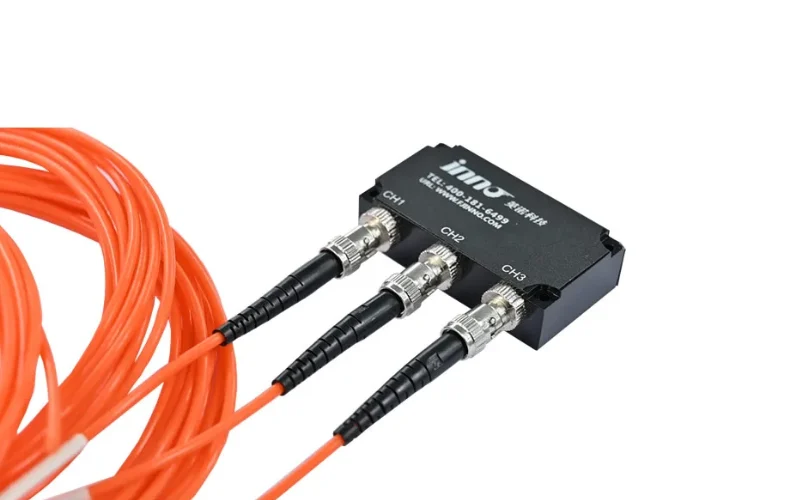
- Dielectric and EMI-immune: no metal at the tip, so probes work safely against energized parts. The reasoning is explained in high-voltage temperature measurement.
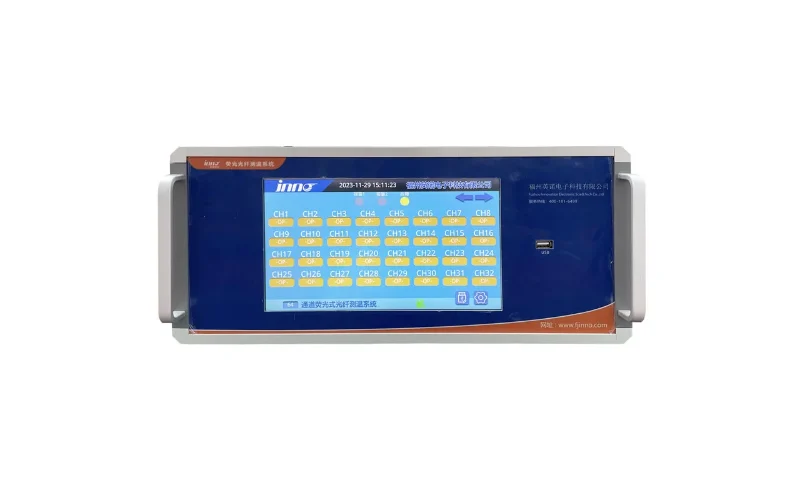
- Probe options: polyimide fiber optic sensors for transformer windings suit resin and dry-type windings, while other fluorescent probes cover oil-immersed designs.
Calculated outputs
- Instantaneous relative aging rate.
- Cumulative loss of life since commissioning.
- Safe overload capacity for a given duration.
- Bubble formation risk when combined with moisture data.
Limits and loading rules are summarized in transformer temperature rise limits and ratings.
9. Clamp-On Current Sensor: Core and Clamp Ground Current Monitoring
What the signal shows
Power transformer cores are grounded intentionally at a single point. When core insulation fails and a second ground path forms, circulating currents cause local overheating and gas generation.
Measurement and thresholds
- Sensor: clamp-on current sensors on the core and clamp ground leads, simple and inexpensive.
- Normal values: very small. Many utilities investigate above roughly 100 mA, although the right threshold depends on the design.
- Confirmation: a rising core ground current together with thermal gases in DGA is a strong sign of a core insulation fault.
10. Oil Level Transmitter, Pressure Sensor, OLTC Monitor and Surge Recorder
Supplementary online indicators
- Oil dielectric sensors: estimate oil dielectric properties or contamination. Less established than DGA and moisture sensors, so treat as supplementary.
- Transient overvoltage recording: logging lightning and switching surges helps explain sudden changes in PD, DGA or bushing readings.
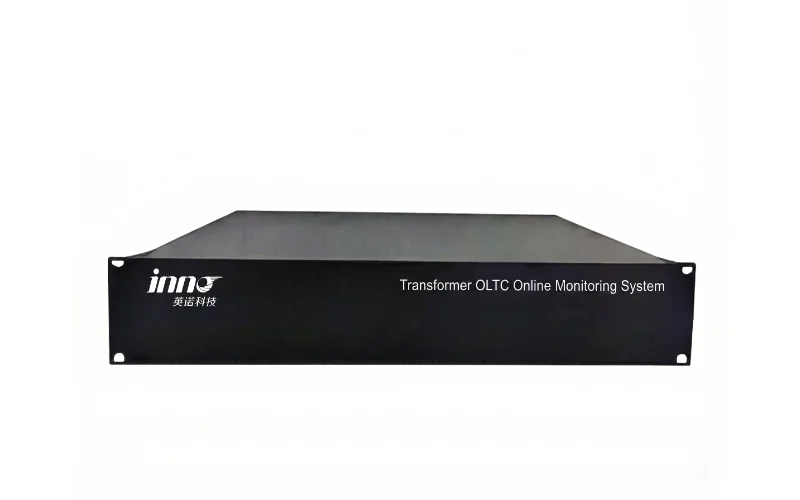
- OLTC condition: tap changer faults produce gas and heat that distort main tank diagnosis. An OLTC online monitoring system helps separate these effects.
- Oil level and pressure: low oil level can expose insulation, and pressure trends in sealed units can reveal gas generation. See the transformer oil temperature, level and pressure monitoring system for typical sensor sets.
11. Offline Test Equipment: Insulation Tester, FDS/DFR Analyzer, SFRA Set and Furan Lab Analysis
Tests that stay offline
| Test | Why It Is Offline | When to Perform |
|---|---|---|
| Winding insulation resistance and polarization index | Needs DC test voltage on a de-energized unit | Commissioning, routine outages, after events |
| Winding power factor / tan delta | Needs isolation and controlled test voltage | Commissioning and periodic outages |
| Frequency domain spectroscopy (FDS/DFR) | Needs de-energized windings and low-frequency measurement | When paper moisture must be quantified accurately |
| Sweep frequency response analysis (SFRA) | Detects mechanical winding deformation, needs outage | After short circuits, transport or relocation |
| Furan analysis and paper DP | Needs laboratory analysis of oil or paper sample | Periodically for aging, DP during internal inspection |
| Oil quality tests | Breakdown voltage, acidity and interfacial tension are lab tests | Every one to a few years |
Combining both approaches
Online monitoring detects change early and continuously. Offline tests give accurate baselines, confirm alarms and measure properties sensors cannot reach. Comparing online DGA vs oil sampling shows how the two complement each other.
12. Dry-Type Insulation Monitoring: Temperature Controller, Humidity Sensor and PD Detector
Parameters that replace oil data
Dry-type units have no oil, so DGA and oil moisture do not apply. Monitoring focuses on the following:
- Winding temperature: governs resin and varnish aging and is limited by insulation class.
- Partial discharge: especially in cast resin units, where voids and cracks are the main defects.
- Humidity and condensation: can cause surface tracking when a de-energized transformer is re-energized.
- Dust and contamination: promote surface discharge and block cooling airflow.
- Fan operation: cooling failure raises winding temperature quickly.
Controller options
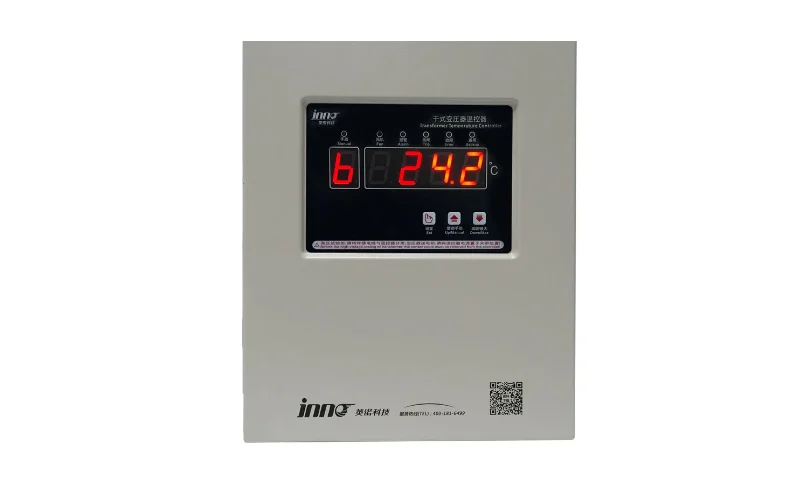
Panel controllers such as the IB-S201 dry-type transformer temperature monitor and controller handle temperature and fan control locally. Projects needing wider condition data can add an Hệ thống giám sát sức khỏe trực tuyến thông minh dành cho máy biến áp khô.
13. Priority Matrix: DGA Monitor vs Hot-Spot Sensor vs Bushing Monitor vs PD System
Suggested order of installation
| Priority | Online Measurement | Lý do |
|---|---|---|
| 1 | DGA with moisture | Covers the widest range of insulation faults with one instrument |
| 2 | Winding hot-spot temperature | Governs aging rate and loading capability, specify at purchase for direct measurement |
| 3 | Giám sát ống lót | High failure consequence, straightforward at higher voltages |
| 4 | Phóng điện cục bộ | Valuable for high-voltage units, suspect units and after DGA shows PD signatures |
| 5 | Core ground current | Low cost, useful where core faults are a known risk |
Adjusting the order
- Voltage class: higher voltage raises the value of PD and bushing monitoring.
- Age and history: older units with gas or moisture history move DGA and moisture sensing to the top.
- Failure consequence: critical or hard-to-replace units justify the full set. Matching scope to criticality is covered in Các phương pháp và chiến lược giám sát tình trạng máy biến áp.
14. FAQ: Transformer Insulation Monitoring Questions
Can insulation resistance be monitored online?
Not in the traditional sense. Insulation resistance and polarization index tests need DC voltage on de-energized windings. DGA, moisture, PD and bushing monitoring supply continuous insulation information instead.
Can the remaining life of paper insulation be measured online?
Not directly. Paper DP requires a physical sample. Online systems estimate paper condition from hot-spot temperature history, moisture and CO/CO₂ trends, and these estimates can be checked against laboratory furan analysis.
Which online measurement detects the most insulation problems?
DGA covers the widest range, including partial discharge, arcing, overheating and paper degradation. Results improve when combined with hot-spot temperature and moisture data.
Is PD monitoring necessary if I already have DGA?
DGA detects PD indirectly through hydrogen and other gases, but cannot locate the source or show the discharge pattern. Direct PD monitoring adds early warning, especially for high-voltage transformers and units with suspected defects.
Does online monitoring replace offline insulation testing?
No. Online monitoring reduces outage frequency and catches fast-developing faults, while offline tests such as winding power factor, FDS and SFRA remain essential for baselines and detailed diagnosis.
How accurate is online paper moisture estimation?
Accuracy depends on steady temperature and equilibrium between oil and paper. Use estimates to rank risk and trend change, and confirm with an FDS/DFR test before any drying decision.
Which sensors can be retrofitted to a transformer in service?
DGA and moisture monitors on drain valves, HFCT and acoustic PD sensors, bushing tap adapters and clamp-on core ground sensors can all be added in service or during a short outage. Winding fiber optic probes are normally embedded during manufacture or rewinding.
How do I choose an insulation monitoring scope for my transformers?
Collect rating, voltage class, age, oil test history and failure consequence, then send the data to the engineering team for a matched monitoring scheme.